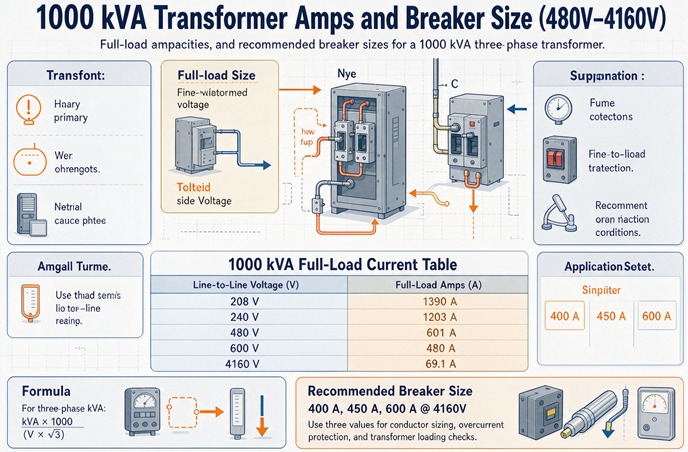
A 1000 kVA transformer carries 1,203 amps at 480 volts three phase and 138.8 amps at 4,160, because amps are 1,000,000 divided by 1.732 times line-to-line voltage. The 480 volt secondary breaker is 1,600 amps: 125 percent of 1,203 is 1,504, and 1,504 is not a rating you can buy. Same transformer, two windings, two different protection stories.
That is the whole answer for most people, and it is where every page on the first page of results stops. The problem is that 1,600 is not one decision. It is the end of four decisions that each use a different rule, and three of them have thresholds that land inside a 1,000 kVA unit for the first time. The 800 amp line where next-size-up stops being allowed. The 1,000 amp line where ground fault protection becomes mandatory. The point where three conductors per phase stops being enough.
So this page does the arithmetic in the open, then walks the four decisions, then spends real time on 4,160 volts, because that is where the 125 percent everyone quotes quietly stops applying and most of the pages you have already read go wrong.
The short answer, in two tables
The tables are split because the code is split. Below 1,000 volts you are in Table 450.3(B). Above it you are in Table 450.3(A), and the percentage stops being 125.
1,000 kVA with a winding at 1,000 volts or less
Secondary or primary, this is the low voltage side of the question. Full-load current, 125 percent of it, and the standard device rating above that.
| Voltage | Full-load amps | 125 percent | Device (NEC 240.6) |
|---|---|---|---|
| 208 V | 2,776 A | 3,470 A | 4,000 A |
| 240 V | 2,406 A | 3,007 A | 4,000 A |
| 480 V | 1,203 A | 1,504 A | 1,600 A |
| 600 V | 962 A | 1,203 A | 1,600 A |
Read the 240 and 600 rows again. Both miss a standard rating by a handful of amps, and both pay for it with a frame size. That is the next section.
1,000 kVA with a winding over 1,000 volts
Medium voltage changes the question from “what percentage” to “what can this winding survive until the secondary device clears a fault.” Table 450.3(A) gives a ceiling of 600 percent of primary current for a breaker, or 300 percent for a fused switch, at 6 percent impedance or less.
| Voltage | Full-load amps | 600 percent ceiling | 300 percent ceiling | What people buy |
|---|---|---|---|---|
| 2,400 V | 241 A | 1,444 A | 722 A | 600 A frame, or 400E fuse |
| 4,160 V | 139 A | 833 A | 416 A | 600 A frame, or 250E fuse |
| 4,800 V | 120 A | 722 A | 361 A | 600 A frame, or 200E fuse |
| 7,200 V | 80 A | 481 A | 241 A | 600 A frame, or 150E fuse |
| 12,470 V | 46.3 A | 278 A | 139 A | 600 A frame, or 100E fuse |
| 13,800 V | 41.8 A | 251 A | 125 A | 600 A frame, or 65E fuse |
| 34,500 V | 16.7 A | 100 A | 50 A | 600 A frame, or 40E fuse |
Every row in that table lands on the same hardware, and that is the point. At 4,160 volts a 1,000 kVA transformer draws 139 amps, and the smallest vacuum breaker frame in 5 kV class is 600 amps. The code would let you go to 833. The transformer needs about 139. The switchgear you can actually order is 600. The 125 percent answer of 175 amps is a legal number, and it is not a thing that exists in a catalog.
Why 1,000 kVA is the last small transformer
Run the same three checks on 500 kVA and on 1,000 kVA and watch what flips.
| Check | 500 kVA at 480 V | 1,000 kVA at 480 V |
|---|---|---|
| Full-load current | 601 A | 1,203 A |
| Device at 125 percent | 800 A | 1,600 A |
| NEC 240.4(C), next size up above 800 A | Allowed, device is exactly 800 | Not allowed, conductor must carry 1,600 |
| NEC 230.95 ground fault protection | Not triggered, device is under 1,000 A | Required on a 480Y/277 service, device is over 1,000 A |
| Conductors per phase | Two sets | Three sets, or four |
| Usual answer | A switchboard | A switchboard with a ground fault relay |
Three separate code thresholds sit between these two machines. A 500 kVA unit is a big panel job. A 1,000 kVA unit is switchgear, and the reason is not the kVA, it is that the current crosses 1,000 amps.
There is an arithmetic coincidence worth keeping in your head. A 1,000 kVA unit at 480 volts carries 1,203 amps. A 500 kVA unit at 240 volts also carries 1,203 amps. Same number, half the kVA, and the 240 volt version is the one with the four thousand amp main and eight sets of conductors. Whenever a number looks familiar on a drawing, check which voltage it came from.
The three numbers, one machine
For the 480 volt case, three values hang off the same transformer and only one of them is 1,203.
| What it is | Where it comes from | Value |
|---|---|---|
| Rated full-load current | 1,000,000 divided by 1.732 divided by 480 | 1,203 A |
| Conductor design current | 125 percent for continuous duty, NEC 215.2 | 1,504 A |
| Overcurrent device | 125 percent per 450.3, next standard rating up | 1,600 A |
The 1,203 is a thermal limit on the winding. The 1,504 is what a feeder gets sized on when the load is continuous. The 1,600 is a device you can order. Put 1,203 on a feeder and you built for 80 percent of the load. Put 1,600 on the cable and you have a conductor that cannot carry the device protecting it, which is the failure that shows up in plan review rather than in the field.
125 percent is a ceiling, not a target
Article 450 says the device shall not exceed 125 percent. It does not say it should be 125 percent. Those are different sentences, and the difference is 400 amps on this transformer.
The reason the ceiling is generous is inrush, and on a 1,000 kVA unit you can see both ends of the window.
| Event | Magnitude at 480 V | Duration | What it sets |
|---|---|---|---|
| Full-load current | 1,203 A | continuous | conductor ampacity |
| Inrush, 8 to 12 times | 9,622 to 14,434 A | about 0.1 s | instantaneous trip |
| Bolted fault at 5.75 percent impedance | 20,918 A | until cleared | interrupting rating |
A 1,600 amp thermal-magnetic breaker with a fixed magnetic trip at ten times rating picks up at 16,000 amps. That sits above the 14,434 amp worst case inrush and below the 20,918 amp fault. Both margins are real, and neither is generous. The inrush margin is 11 percent. The fault margin is 31 percent.
The 1,200 amp frame that looks fine and is not
Take the 1,203 amp winding and put a 1,200 amp frame on it. The long-time pickup can be set at 1,200, which is under the winding rating, so it protects the transformer beautifully on paper. Then energize it.
Inrush at 12 times is 14,434 amps. A 1,200 amp frame with a 10 times magnetic trip picks up at 12,000. The breaker sees a number above its pickup and opens. It does this on the first close of the day, every day, and not on the second close, because the core is already partly magnetized and the flux offset is smaller. That pattern gets diagnosed as a bad breaker about half the time, and it is not a bad breaker.
The 1,600 amp device fixes this by accident. It is the code answer and it is also the inrush answer, and the 400 extra amps of headroom are exactly the margin you need.
Where the 125 percent does not help
Two situations where the ceiling is irrelevant.
A 1,000 kVA unit with a 480 volt primary and a 208Y/120 secondary is 1,203 amps in and 2,776 amps out. Both sides are under 1,000 volts, both use Table 450.3(B), and the primary can legally go to 250 percent, which is 3,007 amps, rounded down to 3,000 under Note 3. Nobody does it. The primary device already rides inrush at 1,600, and a 3,000 amp main on the high side of a 1,000 kVA transformer is a switchboard you cannot justify.
The second situation is a medium voltage primary, and it gets its own section below, because 125 percent simply is not the rule there.
The three amp miss that costs a frame size
Look at the 600 volt row again. Full-load current is 962.3 amps. Multiply by 1.25 and you get 1,202.8. NEC 240.6(A) lists 1,200 as a standard rating. The calculated ceiling is 2.8 amps above it.
The code says the device shall not exceed 125 percent, and where that value does not correspond to a standard rating, the next higher standard rating is permitted. 1,202.8 does not correspond to 1,200, because it is larger. So the next higher standard rating is 1,600. Not 1,200.
| Voltage | Full-load amps | 125 percent | Nearest standard below | Result |
|---|---|---|---|---|
| 240 V | 2,405.6 A | 3,007.0 A | 3,000 A | 4,000 A |
| 480 V | 1,202.8 A | 1,503.5 A | 1,200 A | 1,600 A |
| 600 V | 962.3 A | 1,202.8 A | 1,200 A | 1,600 A |
Two of the three rows miss by single digit amps and both jump a frame. The 240 volt row misses 3,000 by 7 amps and lands on 4,000, which is the difference between a 3,000 amp section and a 4,000 amp section of switchboard. The 600 volt row misses by 2.8 amps and lands on 1,600.
This is not a rounding error in the code. It is the code working as written, and the fix is not to shave the number. It is to notice it early, because a 600 volt switchboard quoted at 1,200 amps and delivered at 1,600 amps is a change order.
Why 1,200 does not get a pass
Someone will argue that 1,202.8 is close enough to 1,200 and the breaker has a tolerance band. It does, and the tolerance is in the trip curve, not in the rating. The rating is the number printed on the label and on the submittal. A plan reviewer compares 1,202.8 to 1,200 and moves on to the next sheet.
If you want 1,200 amps of protection on a 962 amp winding, the way to get it is a 1,600 amp frame with an adjustable trip unit set to 1,200. The frame is what the bus and the lugs and the label are built for. The setting is what the coordination study asks for. Those are two different fields on two different documents, and conflating them is how a 1,200 amp long-time pickup ends up on a 1,600 amp frame with no one able to say who set it.
480 volts: the device, the conductor, and the third set
The 1,600 amp device is the easy part. The conductor is where the third set comes from.
NEC 240.4(C) says that for a device rated over 800 amps, the conductor ampacity must be at least the device rating. There is no next-size-up allowance. Above 800 amps the conductor has to carry the breaker, not the load. So the question is not “what carries 1,504 amps,” it is “what carries 1,600.”
| Conductor set | Copper at 75 C, per set | Three sets | Four sets |
|---|---|---|---|
| 500 kcmil | 380 A | 1,140 A, fails | 1,520 A, fails |
| 600 kcmil | 420 A | 1,260 A, fails | 1,680 A, passes |
| 750 kcmil | 475 A | 1,425 A, fails | 1,900 A, passes |
| 1,000 kcmil | 545 A | 1,635 A, passes | 2,180 A, passes |
Two clean answers, and they are not the same job. Three sets of 1,000 kcmil, or four sets of 600. Three sets is twelve conductors in a switchboard instead of sixteen, so it looks like the better answer, and on a long pull it usually is not, because 1,000 kcmil is a hard pull and not every main lug takes it.
Aluminum changes the count. At 75 C, 1,000 kcmil aluminum carries 460 amps, so three sets give 1,380 and fail. You need four sets of 1,000 kcmil aluminum to clear 1,600. Same transformer, same breaker, a different amount of metal in the room.
The bundle rule that eats the table
Every ampacity above assumes three current-carrying conductors in a raceway. That is the condition the table is built for. Put all three sets in one conduit and you have nine current-carrying conductors, and NEC 310.15(C)(1) applies an adjustment factor of 70 percent.
| Arrangement | Conductors in the raceway | Adjustment | Total ampacity |
|---|---|---|---|
| Three sets, one per raceway | 3 per raceway | none | 1,635 A, passes |
| Two sets in one raceway | 6 | 80 percent | 872 A, fails |
| Three sets in one raceway | 9 | 70 percent | 1,145 A, fails |
| Four sets in one raceway | 12 | 50 percent | 1,090 A, fails |
The table says three sets carry 1,635 amps. The same three sets in one 4 inch conduit carry 1,145. Nothing about the copper changed. This is why parallel transformer feeders are almost always run as separate raceways, one set each, and why a contractor who bundles them to save conduit is the one who gets the red tag.
The lug is part of the answer
A third thing that does not appear in any ampacity table. Three 1,000 kcmil conductors per phase need a landing with three holes per phase that accept 1,000 kcmil, and the neutral and ground add to the count. A 1,600 amp switchboard main section with a 2,000 amp bus often ships with lugs that take two 750s per phase, which is 950 amps of landing capacity and 1,600 amps of label.
Ask for the lug arrangement in the submittal, not after. The same conversation decides whether you are pulling cable at all, because above roughly 1,600 amps in a single run, busway is usually cheaper than copper and it sidesteps the bundling math entirely.
The 1,000 amp line: ground fault protection
This is the part of a 1,000 kVA job that surprises people, and it has nothing to do with the transformer.
NEC 230.95 requires ground fault protection of equipment on solidly grounded wye services rated 1,000 amps or more at 480Y/277 or 600Y/347, with a maximum setting of 1,200 amps and a time delay for coordination. NEC 215.10 applies the same idea to feeder disconnects at 1,000 amps or more.
A 1,000 kVA unit at 480 volts carries 1,203 amps, so the device is 1,600, which is over 1,000. If the secondary is 480Y/277, the service or the main feeder disconnect now needs a ground fault sensor, a relay, and a shunt trip.
| Secondary | Full-load amps | Device | Ground fault protection |
|---|---|---|---|
| 480Y/277, solidly grounded | 1,203 A | 1,600 A | Required, 1,200 A max setting |
| 480 V delta, three wire | 1,203 A | 1,600 A | Not triggered by 230.95 |
| 600Y/347 | 962 A | 1,600 A | Required, device is over 1,000 A |
Read the second row. A 480 volt delta secondary carries the same 1,203 amps, gets the same 1,600 amp device, and does not trigger 230.95, because the article is written for solidly grounded wye systems. A 1,000 kVA unit is the size where that choice starts showing up on the switchgear drawing instead of in a footnote.
What the relay actually does
The setting is 1,200 amps, which is below the 1,600 amp breaker rating. That is the point. A low level arcing fault on the secondary, say 800 amps into a high resistance connection, will not trip a 1,600 amp long-time curve for a very long time. It will sit there and heat a bus bar until something gives. A ground fault relay set at 1,200 amps with a short time delay sees the current going where it should not and opens the main.
That is why the requirement is written for services and feeders over 1,000 amps and not for everything. Below that current the fault energy is small enough that the ordinary overcurrent device is judged adequate. Above it, it is not.
Where the requirement does not follow you
A delta secondary avoids 230.95 but does not avoid the design question. If the building needs 277 volt lighting, you need 480Y/277, and then you need the relay. If everything downstream is 480 volt three phase motors and the 120 volt loads have their own small transformers, a 480 volt delta secondary is a legitimate design and the relay goes away.
Be careful with corner grounded delta and with ungrounded systems. Corner grounded delta is a grounded system with a grounded conductor, and it brings its own rules about which conductor is grounded and how it is identified. Ungrounded systems bring ground fault detection requirements of a different kind, usually an alarm rather than a trip. Neither is a way to avoid thinking about it.
The 22 kA knife edge
Fault current is rated current divided by impedance, and at 1,000 kVA and 480 volts, that division lands right on top of a standard switchgear rating.
| Impedance | Fault current at 480 V | Switchgear that covers it |
|---|---|---|
| 4.0 percent | 30,070 A | 42 kA, or current limiting |
| 5.0 percent | 24,056 A | 25 kA, or 42 kA |
| 5.47 percent | 22,000 A | 22 kA, exactly |
| 5.75 percent | 20,918 A | 22 kA, with 1.1 kA to spare |
| 6.0 percent | 20,047 A | 22 kA |
| 8.0 percent | 15,035 A | 22 kA, and see below |
The number to remember is 5.47 percent. That is 1,202.8 divided by 22,000, and it is the lowest impedance at which 22 kA switchgear still works. Standard 1,000 kVA distribution units are quoted at 5.75 percent, which clears 22 kA by about 1,100 amps. Ask for 5.0 percent because a catalog page said it regulates better, and the fault current goes to 24,056 and the 22 kA gear is now undersized by 9 percent.
| What you ask for | What you get | What it costs you |
|---|---|---|
| 5.75 percent | 20,918 A | 22 kA switchgear, standard price |
| 5.0 percent | 24,056 A | 25 or 42 kA switchgear, or a series rated combination |
| 4.0 percent | 30,070 A | 42 kA switchgear, or current limiting fuses |
| 8.0 percent | 15,035 A | 22 kA switchgear, and a slower trip |
The high impedance trap
Look at the bottom row and then look back at the instantaneous trip.
At 8 percent impedance the bolted fault at the secondary terminals is 15,035 amps. The 1,600 amp breaker with a fixed magnetic trip at ten times rating picks up at 16,000. The fault is below the pickup. The breaker does not trip instantaneously on a bolted fault at its own terminals. It waits for the short time delay or the long time element, and it clears eventually, and the arc has that much longer to do damage.
That inverts the usual intuition. Higher impedance is sold as safer because it limits fault current. It also shrinks the gap between inrush and fault until a fixed instantaneous setting falls outside it. On a 1,000 kVA unit at 480 volts, the useful window runs from about 14,400 amps of inrush to about 21,000 amps of fault, and 8 percent impedance puts the fault below the top of it.
The fix is an adjustable trip unit with a short time delay, set by someone who has the coordination study in front of them. Not a bigger breaker, which makes this worse, and not a smaller one, which trips on inrush.
4,160 volts: where 125 percent stops being the rule
This is the section the other pages skip, and it is the one the keyword asks for.
A 1,000 kVA transformer with a 4,160 volt primary and a 480 volt secondary carries 138.8 amps on the high side and 1,202.8 on the low side. Two windings, one transformer, and two completely different articles.
| Side | Full-load amps | Governing table | Ceiling |
|---|---|---|---|
| 4,160 V primary | 138.8 A | Table 450.3(A) | 833 A breaker, or 416 A fuse |
| 480 V secondary | 1,202.8 A | Table 450.3(A), 1,000 V or less column | 1,504 A, so a 1,600 A device |
The 4,160 volt device is not 173 amps. It is anything up to 833, and the practical answer is a 600 amp frame because that is the smallest one built for 5 kV class.
Why Article 450 treats medium voltage differently
Below 1,000 volts, the overcurrent device is the transformer’s overload protection. There is no other device in the circuit watching the winding temperature, so the device has to be tight, which is why the ceiling is 125 percent.
Above 1,000 volts, the assumption is that the transformer has its own thermal protection and that the primary device is there to clear faults, not to track overload. A medium voltage breaker with a relay can be set to follow a curve, and the code gives it room to sit above inrush and below the fault. That room is 600 percent.
| Location | Impedance | Primary breaker | Primary fuse | Secondary over 1,000 V | Secondary 1,000 V or less |
|---|---|---|---|---|---|
| Any | 6 percent or less | 600 percent | 300 percent | 300 percent breaker | 125 percent |
| Any | Over 6, up to 10 percent | 400 percent | 300 percent | 250 percent breaker | 125 percent |
| Supervised | Any | 300 percent | 250 percent | Not required | Not required |
Two things to notice. The 1,000 volt or less column stays at 125 percent no matter what, so the 480 volt side of a 4,160 volt unit gets the same 1,600 amp device as a 480 volt unit fed from 13.8 kV. And at any location that is not supervised, the secondary device is not optional. There is no primary only option in the medium voltage table.
The 6 percent cliff, at 4,160 volts
The impedance band matters more than the percentage here. A 1,000 kVA unit at 5.75 or 6.0 percent impedance sits in the generous band, and the primary breaker ceiling is 600 percent, which is 833 amps. The same unit ordered at 6.5 percent drops to 400 percent, which is 555 amps, and 555 is below the smallest frame you can buy.
| Impedance | Band | Ceiling at 600 percent | Ceiling at 400 percent | What fits |
|---|---|---|---|---|
| 5.75 percent | 6 or less | 833 A | not applicable | 600 A frame, with 233 A to spare |
| 6.0 percent | 6 or less | 833 A | not applicable | 600 A frame, with 233 A to spare |
| 6.5 percent | over 6 | not applicable | 555 A | 600 A frame, setting has to come down |
| 7.5 percent | over 6 | not applicable | 555 A | 600 A frame, setting has to come down |
At 4,160 volts the cliff does not change the hardware, and it does change the setting. At 5.75 percent the 600 amp frame sits 233 amps inside an 833 amp ceiling and nobody has to think about it. At 6.5 percent the ceiling is 555, which is under the frame rating, so the frame stays 600 and the long time setting comes down to something like 400. Same purchase order, different label, and the difference decides whether the submittal gets a comment.
At 13.8 kV on the same kVA, the primary current is 41.8 amps and the cliff moves the frame question from a 300 amp breaker to a 175. That one is a real order change. Same table, different voltage, different consequence.
What you actually order at 5 kV
The frame is 600 amps. That is not a code number, it is what the switchgear catalog sells, and it is four times the transformer current. Inside that frame you choose a sensor or a trip setting, and 200 amps is the usual landing point for a 139 amp winding, because it sits above the 12 times inrush of 1,666 amps only when you look at the time current curve, not the pickup number.
If you go with a fused load interrupter switch instead of a breaker, the fuse is sized on inrush rather than on 450.3. The working rule is 1.5 to 2 times full-load current, so a 250E fuse on a 139 amp winding, and 250 amps is comfortably under the 416 amp ceiling that Table 450.3(A) allows for a fuse at 6 percent impedance. The 250E clears a secondary fault, holds through energization, and costs a fraction of a breaker and a relay.
| Option | Device | Why you pick it |
|---|---|---|
| Vacuum breaker | 600 A frame, 200 A sensor | Resettable, coordinates with downstream, relay settings |
| Fused load interrupter switch | 250E fuse | Cheaper, faster clearing, no settings to get wrong |
| Both | 600 A frame plus a 250E | Redundant, and someone has to own the coordination |
Cable at 4,160 volts is not sized by amps
138.8 amps needs 1/0 copper at 75 C, which carries 150. It is a 15 kV class cable with shielding and a 60 kV BIL rating for the 5 kV system, and the minimum practical size in most specifications is 2 AWG or 1/0 regardless of current. So the ampacity calculation is not what drives the cable. The standard and the pulling tension do.
What does drive the design is the fault current on the 4,160 volt side and the interrupting rating of the switch. A 5 kV breaker is typically rated 250 MVA or 350 MVA, which is 28 kA or 39 kA at 4,160 volts, and the transformer contributes far less than that. The limiting factor is almost always the utility’s available fault current at the primary, not the transformer.
2,400 volts, and the rest of the range
The keyword says 480 to 4,160, and 2,400 sits in the middle of that span with its own quirks.
| Voltage | Full-load amps | 600 percent | 300 percent | Note |
|---|---|---|---|---|
| 2,400 V | 240.6 A | 1,444 A | 722 A | 1,200 A frame legal, 600 A usual |
| 4,160 V | 138.8 A | 833 A | 416 A | 600 A frame, 5 kV class |
A 1,000 kVA unit at 2,400 volts is the same machine as the 4,160 volt version with a different winding, and the current doubles because the voltage nearly halves. The 2,400 volt system is old industrial distribution, still common in plants built before 1970 and still supported by switchgear. The 600 percent ceiling is 1,444 amps there, so a 1,200 amp frame would be legal on a 241 amp winding, and a 600 amp frame with a 400 amp relay is what most plants actually buy.
The single phase answer is 2,083, and it is a trap
A 1,000 kVA single phase transformer at 480 volts carries 2,083 amps. The three phase answer is 1,203. Same kVA, same voltage, 73 percent more current, because there is no third phase to share the load.
| Single phase voltage | Full-load amps |
|---|---|
| 240 V | 4,167 A |
| 480 V | 2,083 A |
| 600 V | 1,667 A |
| 2,400 V | 417 A |
| 4,160 V | 240 A |
| 12,470 V | 80.2 A |
The trap is that 2,083 is also what you get from the three phase formula when you forget the 1.732, and it is also what you get if you type 277 instead of 480. Three roads, one answer, all wrong for a three phase unit. If a drawing shows 2,083 amps next to a 1,000 kVA three phase transformer, the number did not come from the transformer.
Coil current, the other wrong number
Inside a delta winding, each coil carries line current divided by 1.732. On a 1,203 amp line, the coil carries 694.5 amps.
| Quantity | Value at 480 V | Where it belongs |
|---|---|---|
| Line current | 1,203 A | cable, breaker, bus |
| Delta coil current | 694.5 A | winding resistance, winding temperature |
| Wye phase current | 1,203 A | same as line, no division |
The 694 is a real number and it is correct for what it describes. It never belongs in a cable schedule. A 694 amp conductor on a 1,203 amp line is a 42 percent undersize, and it will run hot from the day it is energized.
1,000 kVA next to 750 and 1,500
1,000 kVA is a standard rating on both the liquid immersed and dry type ladders, so it is normally a stock or short lead item. The neighbors are what decide whether you actually buy it.
| Rating | Full-load amps at 480 V | 125 percent | Device | Conductors |
|---|---|---|---|---|
| 750 kVA | 902.1 A | 1,128 A | 1,200 A | Three sets of 600 kcmil, 1,260 A |
| 1,000 kVA | 1,202.8 A | 1,503.5 A | 1,600 A | Three sets of 1,000 kcmil, 1,635 A |
| 1,500 kVA | 1,804.3 A | 2,255 A | 2,500 A | Five sets of 1,000 kcmil, 2,725 A |
Look at what happens to the conductor count between 1,000 and 1,500. The kVA goes up 50 percent and the sets go from three to five, and the individual conductor cannot reasonably get bigger, because 1,000 kcmil is already at the edge of what most switchgear lugs and most pulling equipment handle. Above this size the answer is busway or a second transformer, not more cable.
The 1,359 kVA cliff
Dividing 1,635 amps by the 480 volt constant of 1.203 amps per kVA gives 1,359 kVA. That is the largest transformer you can feed with three sets of 1,000 kcmil copper under 240.4(C), and it sits between 1,000 and 1,500 with nothing on it, because 1,359 is not a standard rating.
So 1,000 kVA is not just a standard size. It is the last standard size where three conductors per phase still clears the device, which is part of why the step from 1,000 to 1,500 feels bigger on the switchgear drawing than the kVA suggests.
A 1,250 kVA on the drawing
It appears in industrial specs and in IEC influenced projects. At 480 volts it draws 1,503 amps, which is 1,879 at 125 percent, so a 2,000 amp device, and four sets of 1,000 kcmil. It is not a standard US rating, so the choice is 1,000 running at 83 percent loaded or 1,500 running at 55 percent. The first is a stocked unit with a two week lead time and a hot winding. The second is a bigger order with a longer date and a colder winding, and a switchboard with a 2,500 amp main.
What to put on the RFQ
The amp numbers come back wrong when the request is thin. These are the fields that change the answer.
| Field | Why it changes the amps |
|---|---|
| kVA | the numerator, and the only field everyone includes |
| Primary voltage and connection | delta or grounded wye changes the current and the ground fault answer |
| Secondary voltage and connection | 480 delta versus 480Y/277 decides whether you need a ground fault relay |
| Percent impedance | does not change rated current, changes fault current from 15 kA to 30 kA |
| Winding voltage class | under or over 1,000 volts decides which table, which is a factor of five |
| Temperature rise | 55, 65, or 80 C rise changes the kVA you can actually carry at ambient |
| Cooling class | ONAN versus ONAF changes the rating, so it changes the amps |
| Winding material | copper or aluminum changes the conductor count, not the amp rating |
| Efficiency compliance | 10 CFR 431.196 levels apply to units delivered from April 23, 2029 |
| Elevation and ambient | above 1,000 m or 40 C, the kVA derates and the amps follow |
The two fields that decide the switchgear
Connection and impedance. Those two answers, both of which fit in one line each, decide whether the switchboard has a ground fault relay and whether its interrupting rating is 22 kA or 42 kA. Neither shows up in the kVA and voltage fields that people actually fill in.
Taps move the current too
A 1,000 kVA unit ships with plus and minus 2.5 percent taps, two above and two below. Each step moves the secondary voltage 12 volts at 480, which moves the secondary current about 31 amps.
| Secondary voltage | Current at 1,000 kVA |
|---|---|
| 468 V, one tap down | 1,234 A |
| 480 V, nominal | 1,203 A |
| 492 V, one tap up | 1,174 A |
On the 4,160 volt side the same tap arrangement moves the primary current about 3.5 amps per step, from 142.4 down to 135.4. That is small in absolute terms and large in percentage terms, which is why a relay setting picked off a nameplate without checking the tap position can be 5 percent off on a 139 amp winding.
The utility voltage is a range
Under ANSI C84.1 Range A, a 480 volt service can sit between 456 and 504. At 456 volts a 1,000 kVA transformer delivers 1,266 amps. At 504 it delivers 1,146.
| Service voltage | Current at 1,000 kVA | Difference |
|---|---|---|
| 456 V | 1,266 A | plus 5.3 percent |
| 468 V | 1,234 A | plus 2.6 percent |
| 480 V | 1,203 A | nominal |
| 492 V | 1,174 A | minus 2.4 percent |
| 504 V | 1,146 A | minus 4.8 percent |
FAQ
How many amps is a 1000 kVA transformer at 480 volts?
1,202.8 amps three phase. That is 1,000,000 divided by 1.732 times 480. It is the same whether the secondary is 480 volt delta or 480Y/277, because line current does not depend on the winding connection. The 277 on the nameplate is line to neutral and does not enter the calculation.
How many amps does a 1000 kVA transformer draw at 4,160 volts?
138.8 amps three phase. Double the voltage and you halve the current, so 4,160 volts carries 8.66 times less current than 480. If the primary is 4,160Y/2,400, the line current is still 138.8 and 2,400 is the line-to-neutral value. Using 2,400 in the three-phase formula gives 240.6, which is 73 percent high.
What size breaker do I need for a 1000 kVA transformer?
1,600 amps on a 480 volt secondary. Take 125 percent of 1,202.8, which is 1,503.5, then move up to the next standard rating in NEC 240.6(A). At 208 or 240 volts the same logic gives 4,000 amps. On a 4,160 volt primary the rule changes, and the ceiling becomes 600 percent, or 833 amps.
Why 1,600 amps and not 1,500?
Because 240.6(A) has no 1,500 amp rating. The standard sizes run 1,200 then 1,600. The calculated ceiling of 1,503.5 sits between them, and 450.3 permits the next higher standard rating, so 1,600 is the answer. A 1,500 amp frame exists in some product lines as a special, and it is not a standard rating for code purposes.
What size wire for a 1000 kVA transformer at 480 volts?
Three sets of 1,000 kcmil copper per phase, which gives 1,635 amps at 75 C and covers the 1,600 amp device. Four sets of 600 kcmil also works at 1,680. Four sets of 500 gives 1,520 and fails, because NEC 240.4(C) requires the conductor to carry the device above 800 amps, not just the load.
Does a 1000 kVA transformer need ground fault protection?
On a 480Y/277 solidly grounded service or feeder rated 1,000 amps or more, yes, under NEC 230.95 and 215.10, with a maximum setting of 1,200 amps and a time delay. A 1,000 kVA unit at 480 volts carries 1,203 amps and gets a 1,600 amp device, so it crosses the threshold. A 480 volt delta secondary does not trigger 230.95.
How much fault current can a 1000 kVA transformer deliver at 480 volts?
About 20,900 amps at 5.75 percent impedance, which is 1,202.8 divided by 0.0575. At 5.0 percent it rises to 24,056, and at 4.0 percent to 30,070. The impedance at which 22 kA switchgear stops working is 5.47 percent, and standard units sit just above it.
What is the inrush current of a 1000 kVA transformer?
Eight to twelve times rated current for about a tenth of a second. At 480 volts that is 9,622 to 14,434 amps. It sets the instantaneous trip. A 1,600 amp breaker with a ten times magnetic trip picks up at 16,000 and rides through, while a 1,200 amp frame picks up at 12,000 and trips on the first close of the day.
Why is a 1000 kVA at 600 volts on a 1,600 amp breaker?
Because 962.3 amps times 1.25 is 1,202.8, and 1,202.8 is above the 1,200 amp standard rating. The code lets you round up to the next standard rating, and the next one above 1,200 is 1,600. A 2.8 amp miss costs a frame size, and it is worth catching before the switchboard is quoted.
Is 1000 kVA a standard transformer size?
Yes, on both the liquid immersed and dry type ladders, so it is normally a stock or short lead unit. The steps around it are 750 and 1,500 kVA. A 1,250 kVA on a drawing is not a US standard size, and the practical choice is 1,000 running at 83 percent or 1,500 running at 55 percent.
What size breaker for a 1000 kVA transformer at 4,160 volts?
The code ceiling is 833 amps, which is 600 percent of 138.8, so an 800 amp device would be legal. What you can actually order is a 600 amp frame, because that is the smallest 5 kV breaker built. Most projects use a 600 amp frame with a 200 amp sensor, or a fused switch with a 250E fuse.
Can a 1000 kVA transformer be single phase?
It can, and at 480 volts single phase it carries 2,083 amps instead of 1,203. Single phase units at this size are rare in commercial service and show up on rural utility lines and in furnace or rectifier duty. Watch for 2,083 on a drawing next to a three phase unit, because that number comes from a dropped 1.732.
The numbers to carry away
One thousand kVA is not an amp rating. It is a volt-amp rating, and the amps fall out of the voltage you attach to it: 1,203 at 480, 2,776 at 208, 139 at 4,160, 46.3 at 12,470.
For the 480 volt case, carry three numbers. One thousand two hundred and three is the winding rating and the number the factory tested. One thousand five hundred and four is the design current after the 125 percent that continuous duty requires. One thousand six hundred is the device you can actually buy, and it is also the number the conductor has to carry, the bus has to carry, and the ground fault relay has to sit under.
Then carry the two thresholds that make this size different from a 500 kVA unit. Above 800 amps, next-size-up stops being allowed, so the conductor follows the device instead of the load. Above 1,000 amps, a solidly grounded 480Y/277 service needs ground fault protection, so a 1,000 kVA unit brings a relay that a 500 kVA unit does not.
And carry one warning for the medium voltage side. At 4,160 volts the number is not 173. The 125 percent everybody quotes is a low voltage rule. On the high side of a 1,000 kVA unit the ceiling is 833 amps, the frame is 600, and the winding only ever wanted 139.
Free: Transformer Specification Checklist
The exact RFQ sheet our engineers use — send it and get a quoted proposal within 24h.
Download checklist