Every transformer starts with the core. For buyers in North America and Europe, the four core types that matter are core-type, shell-type, toroidal, and amorphous-alloy, built from silicon steel or amorphous ribbon. Choose the core type first, then match it to your kVA, voltage class, cooling method, and loss budget. The rest of this guide explains each one with the numbers that change your spec and your energy bill.
Most buying guides stop at “there are many types of transformers” and list everything from RF coils to substation units in one pile. That mix is exactly what trips up a procurement lead. This article goes deep on the core, because the core is the part that decides your no-load loss, your short-circuit strength, your footprint, and your 20 year energy cost. We cover the construction split, the materials, and the buyer math, then give you a one page RFQ checklist.
Why “types of transformers” confuses buyers
People sort transformers three different ways and rarely say which one they mean. The first way is by construction, and that is the core type this guide is about. The second way is by cooling: dry-type versus oil-immersed. The third way is by application: power, distribution, instrument, autotransformer, isolation, and special units such as furnace or rectifier transformers.
The core type sits in the first bucket and is independent of the other two. A unit can be a core-type, dry-type distribution transformer, or a shell-type, oil-immersed furnace transformer. Knowing the construction axis keeps you from confusing “core-type” with “dry-type”, a mistake that shows up in plenty of weak specs. If you are deciding between liquid and air cooling, the dry-type guide and the oil versus dry comparison walk that axis separately.
Core-type versus shell-type: the fundamental split
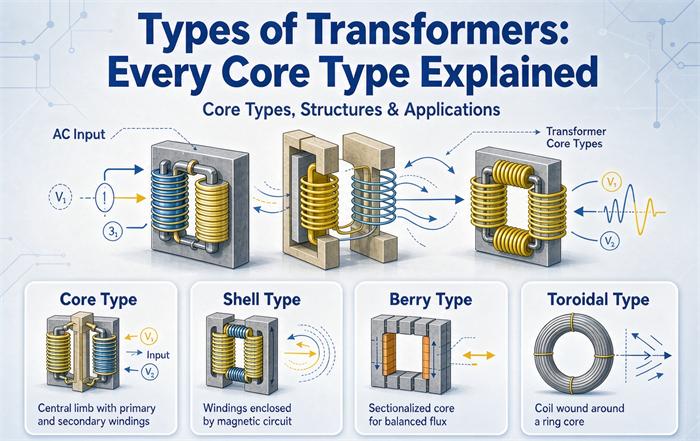
For power and distribution units, the oldest and most important construction question is whether the windings sit on the limbs of a core (core-type) or are wrapped so the core surrounds them (shell-type). Both use the same silicon-steel laminations. The difference is mechanical and service related, not electrical magic.
A core-type transformer has two limbs (or more) with one window each. The windings are easy to access, the design scales cleanly from a few kVA to hundreds of MVA, and most distribution and general power units are built this way. A shell-type unit has the core wrapped around the windings. That geometry gives it better support against short-circuit forces and is the usual choice for large units, furnace transformers, and applications with heavy through-fault duty. The trade-off is harder winding access and a heavier, more complex build at small sizes.
For a typical buyer, the practical rule is simple. Mid size distribution and standard power duty: core-type. Very large units or brutal short-circuit environments: ask your supplier to justify shell-type.
Laminated silicon-steel core: the workhorse
The laminated core made from grain-oriented silicon steel is the default for 50/60 Hz power transformers, and it has been for a century. The steel is rolled into thin insulated laminations, typically around 0.23 to 0.35 mm, so eddy currents stay small. Grain orientation pushes the magnetic flux along the easy axis, which lets the core run near 1.5 to 1.7 tesla without saturating.
This core type wins on cost, availability, and serviceability. It covers the widest kVA and voltage range of any option, from small control transformers to EHV power units. The downside is that it carries a baseline no-load loss. That loss runs every hour the unit is energized, even at zero load, so on a lightly loaded unit it is the number that quietly dominates your bill.
If your load factor is healthy and your priority is first cost plus a proven supply chain, laminated silicon steel is the safe pick. Most of the catalog you will see from a distribution transformer manufacturer uses exactly this core.
Amorphous alloy core: the low-loss option
An amorphous alloy core is built from a metal ribbon that is cooled so fast the atoms never form a crystal lattice. The result is a material with roughly one third the magnetic losses of conventional silicon steel. In distribution class units, that shows up as a no-load loss that can run 70 to 80 percent lower than an equivalent laminated core.
That number matters because no-load loss is the part you pay for 8,760 hours a year. On a unit that sits energized around the clock at a low load factor, an amorphous core can recover its higher material cost through energy savings alone. In the United States, the DOE distribution transformer rules under 10 CFR 431 set no-load loss levels that amorphous cores meet with room to spare, which is why they show up so often in utility and commercial building programs.
The trade-offs are real. Amorphous ribbon is more expensive, more brittle, and a bit noisier if the design is sloppy. It is also a distribution class story, not a 100 MVA power transformer story. You can see a representative build in our amorphous alloy transformer product line. Spec amorphous when the unit runs constantly at a low load factor. Skip it when the load is high and steady and first cost rules.
Toroidal core: compact and quiet
A toroidal core is a continuous ribbon wound into a donut. With no air gap at a joint and a closed magnetic path, it leaks far less stray flux than a stacked core and runs quiet with almost no mechanical hum. That is why you find toroids in audio gear, precision lab supplies, and control power where noise and electromagnetic interference matter.
In the power buyer’s world, toroidal cores appear in smaller dry-type and control transformers, typically below a few MVA. The benefits are a small footprint and low stray field. The drawback is winding: you cannot drop a coil onto a straight limb, so toroidal units cost more to build at scale and are harder to service.
Pick a toroid when footprint, noise, or stray field is the constraint. Pick a stacked core-type when you need the widest size range and the simplest supply chain.
Ferrite and air-core: the electronic grade
A quick word so nobody confuses these with your power transformer. Ferrite cores and air-core transformers dominate high frequency work: switch-mode power supplies, RF circuits, and telecom, running from kilohertz into the megahertz. They are the right tool there and the wrong tool for 50/60 Hz power distribution. If a supplier is pitching you a “transformer” and the spec talks about ferrite and switching frequency, you are in a different product category.
This split also clears up a common mix-up. An autotransformer shares one winding between primary and secondary and gives no galvanic isolation. An isolation transformer keeps the two windings separate on the same core. Same core family, very different safety story, and the difference is decided by the winding scheme, not the core material.
How core type drives your real spec
Once the core type is chosen, it sets several numbers on your spec sheet. The core material decides your no-load loss, which is printed on the nameplate as P0. The construction decides your short-circuit withstand. The size decides your cooling method, and cooling is its own axis covered in the cooling classes guide.
The standards that govern core construction are worth naming in your RFQ. In North America, IEEE C57.12.00 covers general requirements for liquid-immersed units and C57.12.01 covers dry-type. Internationally, IEC 60076-1 sets general requirements, IEC 60076-3 covers insulation levels, and IEC 60076-11 covers dry-type construction. The IEC versus ANSI/IEEE comparison explains where the two systems diverge so you can read a supplier’s claim correctly.
On the energy side, the core type is your main lever on no-load loss. A laminated core at, say, 1,000 kVA might carry a no-load loss in the low single digit kilowatts. An amorphous core of the same rating can cut that by the 70 to 80 percent range. At a typical commercial energy rate over a 20 year life, that gap is often larger than the price difference between the two units. That is the math a routine test report should let you verify before you buy.
Core type comparison table
The table below is the fast version. Use it to narrow the field, then read the sections above for the trade-offs.
| Core type | Core material | Typical kVA and voltage | Loss profile | Best-fit buyer scenario |
|---|---|---|---|---|
| Core-type (wound) | Grain-oriented silicon steel | Wide range, LV to EHV | Moderate no-load loss, design flexible | Distribution and general power, easy service |
| Shell-type (wound) | Grain-oriented silicon steel | Large units, high through-fault | Similar loss, stronger mechanically | Furnace, large power, heavy short-circuit duty |
| Toroidal | Grain-oriented ribbon | Usually below a few MVA, LV or control | Low no-load loss, very low stray field | Control power, noise-sensitive, tight footprint |
| Amorphous alloy | Amorphous metal ribbon | Distribution class, commonly up to several MVA | No-load loss 70 to 80 percent lower | 24/7 operation, low load factor, DOE no-load limits |
| Ferrite or air-core | Ferrite, or no core | Watts to kVA, kHz to MHz | Not applicable at power frequency | Electronics and RF, not power distribution |
Specifying by core type: an RFQ checklist
Write these fields into your specification so a supplier quotes the same thing you are buying.
- Rated kVA and whether the load is continuous or cyclic.
- Primary and secondary voltage, and the frequency (60 Hz for North America, 50 Hz for much of the rest).
- Core construction: core-type or shell-type, with the reason if shell-type.
- Core material: laminated silicon steel or amorphous alloy.
- Cooling method: dry-type or oil-immersed, with the cooling class.
- Enclosure and environment: indoor, outdoor, NEMA rating, altitude, ambient.
- Guaranteed no-load loss P0 and load loss Pk at the referenced temperature.
- Short-circuit withstand level and impedance.
- Standards: IEEE C57 or IEC 60076, named explicitly.
- Test scope: which routine and type tests the unit must pass before shipment.
- Lead time and quote validity window, because both move in 2026.
Common mistakes when choosing a core type
The first mistake is over-specifying amorphous where it does not pay. If your load factor is high and steady, the extra core cost rarely pays back, and laminated silicon steel is the better value. The second is confusing core-type with dry-type. They are separate axes, and a unit can be core-type and dry-type at the same time.
The third mistake is ignoring short-circuit duty. A buyer who sizes only on kVA and skips the through-fault requirement can end up with a unit that survives the nameplate but not the first grid fault. The fourth is treating the core as a line item instead of a 20 year cost decision. Read the no-load loss, then run the energy math.
Bottom line
The core type is the first and most consequential choice on a transformer spec. Core-type and shell-type set your mechanical and service profile. Laminated silicon steel sets your baseline cost. Amorphous alloy trades first cost for a dramatically lower no-load loss that pays back on always-on loads. Toroidal buys you quiet and compact where it counts. Match the core to your kVA, voltage, cooling, and loss budget, write the fields above into your RFQ, and the quote you get back will actually be the unit you need. If you want a core type and loss budget worked through for a specific project, the team at TransNorth Electric can spec it with you before you issue a purchase order. Reach us through the contact page.
FAQ
How many core types of transformers are there?
Buyers usually work with four core types: core-type, shell-type, toroidal, and amorphous-alloy. A fifth grouping, ferrite and air-core, covers high-frequency electronics rather than power distribution. Core type is one of three ways to classify transformers, the others being cooling method and application.
What is the difference between a core-type and a shell-type transformer?
A core-type transformer has windings on the limbs of a two-limb core, which makes them easy to access and service. A shell-type transformer has the core wrapped around the windings, which gives better support against short-circuit forces. Shell-type suits large units and heavy through-fault duty; core-type suits most distribution and general power work.
Is an amorphous core transformer worth the extra cost?
For a unit that runs around the clock at a low load factor, yes. An amorphous alloy core can cut no-load loss by 70 to 80 percent compared with laminated silicon steel, and that loss runs every hour of every year. At a typical commercial energy rate over a 20 year life, the savings often exceed the higher first cost. For a high and steady load, laminated steel is usually the better value.
What is a toroidal transformer used for?
Toroidal cores appear in control power, audio equipment, precision instruments, and smaller dry-type units where low noise and low stray magnetic field matter. They are compact and quiet but cost more to wind at scale, so they are used below a few MVA rather than in large power transformers.
Does the core type decide whether a transformer is dry or oil cooled?
No. Core type and cooling method are independent axes. A transformer can be a core-type dry-type unit or a core-type oil-immersed unit, just as it can be a shell-type oil-immersed furnace transformer. Always specify the core construction and the cooling method as two separate fields.
Which standards cover transformer core construction?
In North America, IEEE C57.12.00 covers general requirements for liquid-immersed transformers and C57.12.01 covers dry-type. Internationally, IEC 60076-1 sets general requirements, IEC 60076-3 covers insulation levels, and IEC 60076-11 covers dry-type construction. Name the standard explicitly in your RFQ so suppliers quote to the same rulebook.
Can one transformer be core-type and dry-type at the same time?
Yes. Core-type describes the winding and limb geometry, while dry-type describes the cooling method. The two are not mutually exclusive, and many distribution transformers are exactly that: core-type, dry-type, air-cooled units. Do not let a supplier use one term to answer a question about the other.
Free: Transformer Specification Checklist
The exact RFQ sheet our engineers use — send it and get a quoted proposal within 24h.
Download checklist