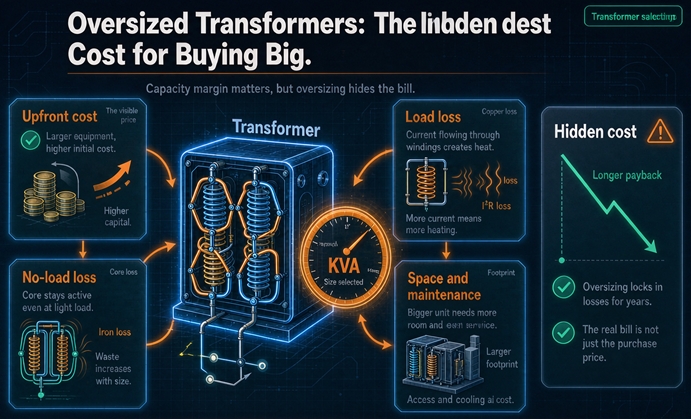
An oversized transformer rarely costs you much in electricity. It costs you in the switchboard it forces, the room it needs, and the capital that sits idle for thirty years. On a 700 kVA load bought as a 2,000 kVA unit, seventy-seven percent of the thirty year penalty has nothing to do with the transformer at all.
The short answer
Buy the smallest standard size that carries your measured peak with the margin the code already gives you. That margin is twenty-five percent, built into the overcurrent protection sizing, and it is not a suggestion. Everything above it is a purchase decision you should be able to defend with a number.
Three things follow from that.
- Size from a meter, not from a panel schedule. A twelve month interval recording of the actual fifteen minute peak is the only load number that does not inflate. A calculated load from connected equipment typically runs 30 to 60 percent high, and every step after that multiplies it.
- Price the consequences, not the kVA. The transformer is a small part of the bill. The switchboard, the fault current rating, the room, the rigging and the arc flash study are the rest of it, and they are all set by the transformer size.
- Treat future growth as a date, not a feeling. Twenty-five percent headroom lasts 7.5 years at three percent growth and 4.6 years at five percent. If nobody can name the year the load doubles, the growth allowance is a guess wearing a number.
| What you are buying | The 1,000 kVA answer | The 2,000 kVA answer | Which one the load needs |
|---|---|---|---|
| Continuous capacity at 480 V | 1,203 A | 2,406 A | 700 kVA, or 842 A |
| Main device, 125 percent | 1,600 A | 4,000 A | 1,200 A |
| Fault current at 5.75 percent | 20,918 A | 41,837 A | same either way |
| Switchboard class | 22 kA | 65 kA | 22 kA |
| Load factor at the metered peak | 70 percent | 35 percent | 100 percent, by definition |
The third column is the point of this article. The right hand column is what a meter would have told you before anybody opened a catalog.
Where the extra kVA comes from
Nobody writes “oversize by 186 percent” on a drawing. It arrives in five steps, and every one of them is defensible when it is made in isolation. Here is the chain on a real shaped project, a plant whose actual peak is 700 kVA.
| Step | kVA | What was written | What was actually known |
|---|---|---|---|
| Metered peak | 700 | 15 minute interval, 12 months | This is the truth |
| Panel schedule | 980 | Connected load times NEC 220 factors | Nobody measured anything |
| Growth allowance | 1,225 | 25 percent for future load | No year attached |
| Phase two spare | 1,470 | 20 percent held back | Not funded, not scheduled |
| Round up | 1,500 | Next standard rating | Plus 2 percent |
| One size up | 2,000 | “For safety” at the bid stage | Nothing |
The product of those five reasonable decisions is 2.86 times the load. The plant opens with a transformer loaded to 35 percent, and the 35 percent is measured against a peak that occurs a few hours a month.
The measurement nobody takes
A fifteen minute interval meter on the service for thirty days will tell you more about transformer sizing than any load study built from drawings. Twelve months is better, because you need the summer and the winter, and you need the one week when the plant ran three shifts.
Three numbers come off that recording.
- The fifteen minute peak, which is the number the utility bills you on and the number the transformer has to carry.
- The load duration curve, which tells you how many hours a year you sit above 70 percent. On most plants it is a few hundred hours.
- The overnight floor, which is the load you cannot turn off. This is the number that decides whether a big transformer will sit at 12 percent load for 6,000 hours a year.
You can rent a recorder for less than the engineering hours spent arguing about demand factors, and it settles the argument permanently.
The shape of the year, which is what actually sizes it
A peak on its own tells you what the transformer must survive. The curve tells you what it will spend its life doing, and that is the part that decides whether buying big is generous or wasteful.
Here is a plausible year for the same 700 kVA plant, taken off the same recording.
| Load at or above | Hours per year | Share of the year |
|---|---|---|
| 700 kVA | 48 | 0.5 percent |
| 630 kVA | 120 | 1.4 percent |
| 560 kVA | 320 | 3.7 percent |
| 490 kVA | 740 | 8.4 percent |
| 420 kVA | 1,450 | 16.6 percent |
| 350 kVA | 2,600 | 29.7 percent |
| 210 kVA | 5,400 | 61.6 percent |
| 70 kVA | 7,900 | 90.2 percent |
Two facts come off that table and they point in opposite directions.
The first is that the 1,000 kVA unit is above 70 percent of its own rating for under fifty hours a year, because 70 percent of 1,000 is 700 and the plant touches 700 a few times a month. So even the small option spends most of its life below the load where the efficiency argument says it should sit.
The second is that the overnight floor is 70 kVA, which is 7 percent of the 1,000 kVA unit and 3.5 percent of the 2,000. At that floor both units are effectively idle, and both burn their full core loss. The difference between them at 3 a.m. is 1,500 watts, and that is the entire real energy cost of the bigger core.
That is why the loss argument is small in both directions. The load never sits where the argument matters. It sweeps from 7 percent to 100 percent and spends most of its hours in the middle, where the two sizes are within a few hundred watts of each other.
Why the panel schedule runs high
NEC Article 220 is a code for making sure the service is adequate, not for predicting what the building will draw. It adds 125 percent to the largest motor, it counts receptacle outlets at 180 VA each whether or not anything is plugged in, it applies demand factors that were derived from housing in the 1960s, and it has no mechanism for the fact that a plant with 2,000 connected horsepower might run 300 of them at once.
That is not a criticism of the code. It is a statement about what the code is for. A calculated load of 980 kVA against a metered 700 kVA is a 40 percent margin that arrived before anybody decided to add a margin.
Then the growth allowance gets applied on top of the code margin, and the phase two allowance on top of that, and each one is a percentage of a number that was already padded.
A load calculation is a legal floor. A metered peak is a fact. Sizing a transformer from the first one and then adding growth on top is how a 700 kVA plant ends up with a 2,000 kVA core.
Seven costs, ranked
I want to put the whole thing on one page, because the debate usually happens one line item at a time and the line items do not compare.
The case is the one above: 700 kVA peak, thirty years, ten cents a kilowatt hour, seven percent discount rate.
| Cost | Thirty year present value |
|---|---|
| Switchboard, 4,000 A at 65 kA instead of 1,600 A at 22 kA | $72,000 |
| Transformer, 2,000 kVA instead of 1,000 kVA | $24,000 |
| Room, pad, door, rigging, arc flash restudy | $18,000 |
| Core and load losses | minus $7,664 |
| Net | $106,336 |
Two things jump out.
The first is that the transformer is less than a quarter of the cost. The switchboard is 68 percent of the total, the transformer is 23, the civil work is 17, and the losses are a credit of 7. The switchboard alone is three times the transformer. That is not a pricing quirk. It is what happens when a size change crosses a fault current class, and it is the single most expensive thing in this decision.
The second is that the losses are negative. The bigger unit burns less electricity than the smaller one at this load, by 705 watts, worth about $618 a year. Every brochure you read will tell you the opposite. They are comparing a unit at 70 percent load against the same unit at 35 percent load, which is not a comparison of two transformers. It is a comparison of two loads.
I will come back to both.
What the ranking survives
The dollar figures above are assumptions. Your quotes will differ, and for a liquid filled unit in a different enclosure they will differ a lot. What does not change is the order.
The switchboard difference is set by the fault current class, and the fault current class is set by the kVA. As long as a 2,000 kVA unit at 5.75 percent impedance produces 41,837 amps, it needs gear rated above 42,000 amps, and gear rated above 42,000 amps is a different product line from gear rated at 22,000. That ratio is a property of the equipment market, not of your project.
The switchboard class, which is the biggest line
Fault current at the secondary is full load current divided by per unit impedance. For a 480 V unit at 5.75 percent, that reduces to one number: 20.9 amps of fault current per kVA of rating.
| Rating | Full load amps | Fault current at 5.75 percent | Gear class the fault forces |
|---|---|---|---|
| 300 kVA | 361 | 6,275 A | 10 kA |
| 500 kVA | 601 | 10,459 A | 22 kA |
| 750 kVA | 902 | 15,689 A | 22 kA |
| 1,000 kVA | 1,203 | 20,918 A | 22 kA |
| 1,500 kVA | 1,804 | 31,378 A | 42 kA |
| 2,000 kVA | 2,406 | 41,837 A | 65 kA |
| 2,500 kVA | 3,007 | 52,296 A | 65 kA |
The line that matters is between 1,000 and 1,500 kVA on the way up, and it sits at 1,052 kVA. That is the rating at which 5.75 percent impedance produces exactly 22,000 amps. Anything above it needs gear rated above 22 kA, and the next catalog class is 42 kA, not 25.
So the equipment ladder and the transformer ladder are out of step. The transformer goes 1,000, 1,500, 2,000, 2,500. The gear goes 22, 42, 65. One transformer step can be one gear step or two, and you do not get to choose which.
The 3,007 amp trap
Here is a detail that costs more money than it should, and it appears at exactly 2,000 kVA.
Primary overcurrent protection at 125 percent of 2,406 amps is 3,007 amps. The standard ratings in 240.6(A) go 2,500, then 3,000, then 4,000. Three thousand and seven amps is seven amps above the 3,000 amp standard size, so the next standard rating up is 4,000 amps.
Seven amps. On a 4,000 amp frame instead of a 3,000 amp frame, and with 240.4(C) requiring conductors with an ampacity at least equal to the device rating above 800 amps, the feeder is no longer a set of cables. It is busway, or it is ten sets of 500 kcmil.
Compare the step below. At 1,500 kVA, 125 percent of 1,804 amps is 2,255, which rounds to 2,500. At 1,000 kVA, 125 percent of 1,203 is 1,504, which rounds to 1,600, and 1,600 amps is four sets of 600 kcmil in parallel.
That is the practical reason the 2,000 kVA column is so much more expensive than the 1,500. It is not the transformer. It is that the transformer’s full load current lands seven amps on the wrong side of a standard breaker rating.
Above 2,000 amps you stop buying cable
There is a second threshold in the same neighborhood. Copper at 75 degrees Celsius carries 545 amps in 1,000 kcmil, which is the largest size most people will pull. Three sets in parallel is 1,635 amps, and that is the last point where a conventional feeder works without heroics.
Three sets of 1,000 kcmil at 480 V carries about 1,359 kVA. A 1,500 kVA unit needs four sets, which is a wider wireway, a bigger pull, and a longer installation. A 2,000 kVA unit at a 4,000 amp device is past the point where anybody sane pulls cable at all.
So the cost of the extra kVA is not linear in kVA. It is a series of steps, and the steps are at 1,052 kVA for the gear class and around 1,359 kVA for the conductor count. Buying one size up from 1,000 lands you on the far side of both.
Fault current scales with kVA, but gear ratings do not. They come in 22, 42 and 65 kA, and the distance between two of those steps is where the budget for this project actually lives.
The capital you spend twelve years early
A transformer bought for load that has not arrived is capital with no job. It does not appreciate, it does not earn, and at the end of its life it is scrap copper and steel.
Take the 700 kVA plant and the three sizes it could plausibly buy, and ask when the load would actually need each one at three percent growth.
| Rating | Load factor today | Years until the load needs it |
|---|---|---|
| 1,000 kVA | 70 percent | 12.1 |
| 1,500 kVA | 47 percent | 25.8 |
| 2,000 kVA | 35 percent | 35.5 |
The 2,000 kVA unit is not fully used until year 35. A distribution transformer’s design life is thirty years, and the last five of those are usually spent at reduced output rather than full. So the honest description of that purchase is capacity that never gets used inside the life of the asset.
The 1,500 kVA unit gets used in year 26, which is at least inside the window. The 1,000 kVA unit gets used in year 12, which means you will be buying again, and that is a real cost too.
This is the genuine tension in the decision, and it is not resolved by rounding up. It is resolved by asking what the second purchase costs. If a second transformer can be added in parallel later, on a pad that was sized for two, with a switchboard that was specified for the final arrangement, then buying the second one in year 12 is cheaper than buying the capacity in year 0.
Residual value is scrap
Nobody plans for this, so I will say it plainly. A used distribution transformer sells for a fraction of its price, and a used unit in a nonstandard size sells for less. The extra kVA you bought has no resale market, no book value beyond depreciation, and no buyer when the plant closes.
Depreciation is not a defense either. A larger asset depreciates more, and the tax shield on the extra capital is worth a fraction of the capital. You are still out the cash.
The losses, which are usually a credit
This is where this page parts company with almost everything written on the subject, including several of the pages currently ranking for this keyword.
The claim is that an oversized transformer wastes energy around the clock because its core is bigger. The core is bigger, and the no-load loss is higher. That part is true. What is missing is the other half of the ledger, which is that load loss falls with the square of the load fraction, and a lightly loaded transformer has almost none.
Total loss at a given load is the no-load loss plus the load loss times the square of the load fraction.
Put a 700 kVA load on a 1,000 kVA unit and the loss is 5,910 watts. Put the same load on a 2,000 kVA unit and it is 5,205 watts. The bigger transformer burns 705 watts less, because at 35 percent load its winding loss is 2,205 watts against 4,410 in the smaller unit at 70 percent, and that 2,205 watt saving more than covers the 1,500 extra watts of core loss.
The crossover moves with the size ratio
There is a clean way to state where the bigger unit stops paying for its bigger core. For units in the same product family, where both losses scale roughly with rating, the crossover load is the peak efficiency load fraction times the square root of the size ratio, all times the smaller rating.
That is 40.8 percent times the square root of the step, so a 1.5 to 1 step crosses at 50 percent of the smaller unit and a 2 to 1 step crosses at 57.7 percent.
| Smaller unit | Larger unit | Size ratio | Crossover load | As a fraction of the smaller unit |
|---|---|---|---|---|
| 500 kVA | 750 kVA | 1.50 | 250 kVA | 50.0 percent |
| 750 kVA | 1,000 kVA | 1.33 | 354 kVA | 47.1 percent |
| 1,000 kVA | 1,500 kVA | 1.50 | 500 kVA | 50.0 percent |
| 1,000 kVA | 2,000 kVA | 2.00 | 577 kVA | 57.7 percent |
| 500 kVA | 1,500 kVA | 3.00 | 354 kVA | 70.7 percent |
Below the crossover, the smaller unit burns less electricity. Above it, the larger one does. So buying one size up costs energy only when the load is under about half of the smaller rating, and the further up the ladder you jump, the wider the band where the bigger unit wins.
The 700 kVA load in this article sits at 700 kVA against a 577 kVA crossover, so the 2,000 kVA unit wins on losses. That is why the ledger shows a credit instead of a charge.
A note on the arithmetic in those tables
The loss figures on this page scale linearly with kVA, at 1.5 watts of no-load loss and 9 watts of load loss per kVA. Real units do not scale that way. Core loss tracks core weight, which grows slower than rating, so a 2,000 kVA unit’s no-load loss is usually less than twice a 1,000 kVA unit’s.
I am using the linear set because it is the same basis published on the loading article elsewhere on this site, and because the error runs against the argument I am making. Linear scaling overstates the big unit’s core loss, which makes the big unit look worse than it is. The conclusion that losses are a minor line item holds with the overstatement in place, so it holds without it.
Where light load really does cost you
The counterexample is severe underload, and it is real. Below about 30 percent of rating, the core loss is the whole bill and the load loss is noise, so a unit three sizes too big is genuinely wasteful.
The 2,000 kVA unit carrying 200 kVA burns 3,180 watts. A 500 kVA unit carrying the same 200 kVA burns 1,470 watts. That is 1.7 kilowatts, 14,900 kilowatt hours a year, about $1,490 at ten cents.
That is a case for not buying four times the load. It is not a case for buying one size up, because one size up rarely lands you under 30 percent.
What it does to the demand charge, which is almost nothing
A common objection is that a bigger transformer raises the demand charge. It mostly does not, and the reason is worth understanding because it cuts the other way too.
Demand is billed on what the meter records, and the meter records the load plus the transformer’s own losses. If the plant draws 700 kW, the meter sees 700 kW plus about 5 kW of transformer loss. It does not see the transformer’s rating anywhere. A 2,000 kVA unit supplying 700 kW bills the same demand as a 1,000 kVA unit supplying 700 kW, plus or minus the loss difference, and at this load the loss difference is negative.
So the demand charge is not an argument against buying big. It is not an argument for it either.
There is one exception, and it is the reactive one. If the tariff bills kVA demand rather than kW demand, the core’s magnetizing current counts, and it counts in proportion to the rating. Thirty kVAR on a 2,000 kVA unit against fifteen on a 1,000 is a difference of fifteen kVAR at the billing peak, which at a typical reactive charge is a few hundred dollars a year and never the deciding number.
The thing to take from this is narrower than it sounds. The transformer rating does not appear on your utility bill. The load does, the losses do, and the reactive draw does. That is why the energy case for either size is weak, and why the case has to be made on the equipment side.
The energy argument for right sizing is the weakest argument available, and it is the one every brochure leads with. Lead with the switchboard instead. It is worth ten times as much.
The power factor at light load
A transformer draws magnetizing current whether or not anything is running. That current is almost entirely reactive, and it is proportional to the rating, not to the load. A typical distribution unit draws about 1.5 percent of its rated current at no load, so a 2,000 kVA unit carries roughly 30 kVAR of reactive burden before the first machine starts.
Put a real load behind it and the numbers move in a way that surprises people.
| Transformer | Core kVAR | At 500 kW | At 300 kW | At 150 kW | At 100 kW |
|---|---|---|---|---|---|
| 500 kVA | 7.5 | 0.946 | 0.943 | 0.935 | 0.927 |
| 1,000 kVA | 15.0 | 0.941 | 0.935 | 0.919 | 0.902 |
| 2,000 kVA | 30.0 | 0.932 | 0.919 | 0.884 | 0.847 |
The load in that table is at 0.95 power factor, which is a good plant. The 500 kVA unit holds the service above 0.92 all the way down to 100 kW. The 2,000 kVA unit drops below 0.90 somewhere between 150 and 100 kW, and 0.90 is the number most tariffs use as the threshold below which reactive power gets billed.
The dollar figure is small. Thirty kVAR charged at three dollars a kVAR month is about $1,080 a year, and most tariffs only charge the excess above half the kW demand, which cuts it further. But three properties of that charge are worth knowing.
It is proportional to the transformer, not to production. It shows up on the bill in a month when the plant is closed. And it is invisible in every energy model that treats the transformer as an ideal element.
The core draws its reactive current at three in the morning, with the lights off and nobody in the building. That is the part of an oversized transformer you cannot switch off.
The inrush against your own main
Energizing a transformer draws a current that has nothing to do with its load. The core saturates on the first half cycle, and the current that flows is limited only by the air core impedance and the source. It runs 8 to 12 times rated current, decays over a tenth of a second to a second, and is fully offset, so it looks nothing like a fault to a thermal element but looks exactly like one to a magnetic element.
On a 1,000 kVA unit that is 14,434 amps. On a 2,000 kVA unit it is 28,868 amps.
The main device is sized at 125 percent of full load current, which is 1,600 amps on the 1,000 kVA unit and 4,000 amps on the 2,000. Its instantaneous element is set at some multiple of that, usually around 10, so the pickup lands at 16,000 and 40,000 amps respectively. The 1,000 kVA unit’s inrush of 14,434 against a 16,000 pickup is an 11 percent margin, and 11 percent is not much when the closing angle and the residual flux both land the wrong way.
This is why transformer mains get specified with an adjustable instantaneous rather than a fixed one, and why a coordination study for a 2,000 kVA service is a bigger piece of work than for a 1,000.
The setting that ends up five times the load
There is a quieter problem. The long time element on that 4,000 amp main has a pickup of 4,000 amps. The actual load is 700 kVA, which is 842 amps at 480 volts.
So the device that protects the service is set at 4.75 times the current the service ever carries. A high impedance fault at 2,000 amps on that bus is below the main’s pickup and above nothing else, and it will sit there until something else clears it or until it becomes a bolted fault.
On the 1,000 kVA option the same ratio is 1.9. The protection is tight, the settings are easy, and the arc flash numbers come out lower because the device clears faster.
The voltage at light load, and the ceiling
Light load means high voltage. A transformer’s secondary sits at its turns ratio value with no load, and drops as load comes on because of the impedance. So the less you load it, the closer it sits to the top.
The size of that drop is set by the impedance and the power factor. At 5.75 percent impedance and 0.9 power factor, the drop from no load to full load is about 3.7 percent. A unit at 35 percent load only uses 1.3 points of it. So an oversized transformer holds its secondary about 2.4 points higher than a fully loaded one would, all year, at every hour.
That matters because the tolerable band has a top. ANSI C84.1 Range A puts the service voltage for a 208 V system between 197.6 and 218.4 volts, and for a 480 V system between 456 and 504.
Now put the two together. A 480 V primary at the top of Range A is 504 volts. Into a 208Y unit with the taps at nominal, that produces 218.4 volts with no load. That is the Range A ceiling, exactly, with nothing running.
So a facility on the high side of its voltage tolerance, with a transformer that is never loaded enough to drop, spends its life at the top of the acceptable band and has no headroom left for a utility regulation change. The correction is a tap, and the tap step is 2.5 percent, which is the entire budget. Tap down 2.5 percent and the full load voltage goes 2.5 percent low, which is the problem you were trying to avoid, just at the other end.
The room, the rig, and the calendar
These are the costs that arrive after the transformer is ordered, which is why they never make it into the comparison.
A 1,000 kVA dry type unit weighs roughly 4,600 pounds. A 2,000 kVA unit weighs roughly 8,400. The second one does not go through the same door, does not sit on the same pad, and does not get moved by the same crew. Floor loading, housekeeping pad dimensions, clear working space under 110.26, ventilation, and the path from the truck to the vault all change with the size, and all of them are construction line items rather than equipment line items.
Then there is the schedule. A 1,000 kVA unit in a standard voltage and enclosure is often a stocked item, two to four weeks. A 2,000 kVA unit is usually built to order, and fourteen to twenty weeks is normal. If the switchgear is being released on the transformer’s submittal, that difference moves the whole project.
And the arc flash study gets redone, because incident energy scales roughly with available fault current at a fixed clearing time. Doubling the fault current roughly doubles the incident energy, and the PPE category boundaries sit at 4, 8, 25 and 40 calories per square centimeter. A board that landed at 3.5 in the original study does not necessarily stay in category 2 when the fault current doubles.
Liquid filled makes the space problem a containment problem
Everything above applies to a liquid filled unit as well, and then adds a regulatory dimension that dry type does not have.
A dry type transformer that is oversized costs you floor area, ceiling height and weight. A liquid filled transformer that is oversized costs you oil. A 1,000 kVA padmount holds roughly 200 to 290 gallons. A 1,500 kVA unit holds about 500. Past 1,320 gallons of aggregate aboveground oil capacity at a site, the SPCC rules apply and you are writing a plan, inspecting it, and keeping records.
One unit rarely crosses that line on its own. The site total does, and it is a total that nobody recalculates when a transformer is upsized. Two 500 kVA units and a 1,500 become a site that needs a plan, and the trigger was a sizing decision made years after the plan question was settled.
There are two smaller differences worth knowing. Liquid filled units have lower no-load loss per kVA than dry type, so the core loss penalty for oversizing is a little smaller and the loss argument matters even less. And a liquid unit’s fault current follows exactly the same arithmetic, so the gear class problem is identical.
Nobody has ever been criticized for buying the bigger transformer. That is exactly why the cost survives, because a decision nobody is blamed for never gets audited.
Six ways to buy headroom without a bigger core
If the goal is capacity for a peak that might arrive, there are cheaper ways to hold it than a larger magnetic core. All of these are available on a 1,000 kVA base.
| Lever | Capacity from the same core | What it costs | The catch |
|---|---|---|---|
| Forced air cooling (AN/AF) | About 33 percent more | Fans, controls, a small premium | Requires airflow, and a failed fan is silent |
| 150 degree C rise instead of 80 | About 18 percent more | Usually less, not more | Higher surface temperature, shorter life at full load |
| Two units in parallel | Doubles, bought in two payments | Second unit, second breaker | Impedance and vector group must match |
| Higher impedance | None | Usually nothing | Cuts fault current, raises regulation and losses |
| K rating | Recovers the derating you were about to apply | 10 to 15 percent premium | Only worth it if the load is actually nonlinear |
| Load management | Cuts the peak instead of raising the ceiling | Controls and discipline | Needs somebody to own it |
The first two are the ones people forget. A fan cooled dry type transformer is a smaller, cheaper unit that carries a third more load when the fans run, and the fans run only when the load is there. That is headroom that costs almost nothing and does not sit idle for thirty years.
The trade is that the AF rating depends on the fans, and fans fail. If you take the AF rating as your design capacity, you need a fan failure alarm and a plan, because the unit reverts to its AN rating the moment airflow stops.
When buying big is the right call
None of the above means oversizing is always wrong. It means the reason has to be a specific one, and it has to be written down. These are the five that hold up.
- A single motor whose start would dip the bus. If a 500 hp motor at six times full load current is starting across the transformer, the voltage dip is set by the transformer’s impedance and rating, and a bigger unit is a legitimate way to buy a softer dip. The arithmetic is the motor’s locked rotor kVA divided by the transformer’s short circuit capacity.
- A load that is genuinely nonlinear. A rectifier bank or a drive heavy lineup derates a standard transformer, and the answer is a K rated unit at the right size rather than a standard unit two sizes up. Those are different purchases and K rating is the cheaper one.
- Ambient above 40 degrees C, or altitude above 1,000 meters. Both reduce capacity, and the correction is applied to the nameplate. This is not oversizing, it is arithmetic, but it lands on a bigger number and it should be documented as the reason.
- A dated expansion with money attached. If the second line is funded, scheduled and drawn, sizing for it is rational. If the expansion is a slide in a strategy deck, it is not a date.
- Redundancy, which is a different purchase. Two half size units in an N+1 arrangement cost more than one big one and deliver something a big one cannot, which is the ability to lose a transformer and keep running. Do not try to buy availability with kVA.
There is a sixth that is newer. Efficiency standards move. A unit bought today is tested against today’s loss table, and the next table takes effect on April 23, 2029 under 10 CFR 431.196. A transformer installed in 2026 will still be running in 2056, under whatever tables exist then, and it will be judged against the standard of the day it was made. Buying a larger core now locks in the loss level of the current table for thirty years, which is an argument for buying the right size and for buying the better efficiency option within it, not for buying more kVA.
The worksheet, before the purchase order
Four numbers decide this. Get them and the argument is over.
- The metered fifteen minute peak over twelve months, in kVA.
- The load duration curve, so you know how many hours a year you are above 70 percent.
- The fault current at the secondary, from kVA and impedance, and the gear class it forces.
- The evaluated cost of the losses, which is a formula rather than an opinion.
That last one is the piece most buyers never run. Utilities have used it for decades to compare transformer bids, and it converts watts into dollars at the moment of purchase.
The evaluated cost is the price plus a capitalized no-load factor times the no-load loss in watts, plus a capitalized load loss factor times the load loss in watts.
The no-load factor is the annual energy cost of one watt, discounted over the life. At ten cents a kilowatt hour, thirty years and seven percent, that is $10.87 per watt. One kilowatt of core loss is worth $10,870, and it is worth that before you have paid for the core.
| Energy price | No-load factor, 30 years at 7 percent |
|---|---|
| $0.08 per kWh | $8.70 per watt |
| $0.10 per kWh | $10.87 per watt |
| $0.15 per kWh | $16.31 per watt |
| $0.25 per kWh | $27.18 per watt |
The load loss factor is smaller because load loss only exists when load does. It is the no-load factor times a loss load factor, which is roughly 0.3 times the load factor plus 0.7 times the load factor squared. At a load factor of 0.5 that is 0.325, so the load loss factor is $3.53 per watt.
Run that against two bids and the cheaper transformer is often not the cheaper transformer. Run it against two sizes and you will find the difference is real but modest, which is the honest result and the one that sends you back to the switchboard line, where the money actually is.
The same 700 kVA, three ways
Here is the whole decision on one page, with the assumptions stated so you can replace them.
| 1,000 kVA | 1,500 kVA | 2,000 kVA | |
|---|---|---|---|
| Load factor at 700 kVA | 70 percent | 47 percent | 35 percent |
| Loss at 700 kVA | 5,910 W | 5,190 W | 5,205 W |
| Thirty year loss, present value | $64,243 | $56,417 | $56,580 |
| Transformer, illustrative | $38,000 | $54,000 | $62,000 |
| Switchboard, illustrative | $120,000 | $175,000 | $210,000 |
| Main device | 1,600 A | 2,500 A | 4,000 A |
| Gear class | 22 kA | 42 kA | 65 kA |
| Long time pickup against 842 A of load | 1.9 times | 3.0 times | 4.75 times |
| Years until 3 percent growth needs it | 12.1 | 25.8 | 35.5 |
The dollar figures for the equipment are illustrative and you should replace them with quotes. The right hand column is not illustrative, and neither are the amps.
Read the last two rows together. The 2,000 kVA unit is not needed until year 35, and it carries a main set at 4.75 times the load. The 1,500 kVA unit is needed in year 26 and sits at 47 percent load today, which is close to where these units are happiest. The 1,000 kVA unit is needed in year 12, which means a second purchase.
The defensible answer for most plants in this position is the 1,500 kVA, because it is the last size that stays inside 42 kA gear with margin and the first size that carries a real growth case. The indefensible answer is the 2,000 kVA, which costs the most, protects the least, and delivers capacity that arrives after the asset is retired.
And the cheapest answer, if the peak is genuinely flat and the growth story has no date, is the 1,000 kVA with the room set aside for a second unit. That is not optimism. It is a hedge that costs a fraction of the capacity it preserves, provided you understand what the hedge does and does not buy.
The parallel hedge, and what it does not fix
Adding a second unit later is the standard advice for avoiding an oversized first purchase, and it is good advice. It has one trap that catches people who read only the first half.
Two 1,000 kVA units in parallel produce exactly the same fault current as one 2,000 kVA unit. Each contributes 20,918 amps, and the bus sees 41,837. The fault current depends on total kVA and impedance, not on how many tanks it arrives in. So if the plan is to parallel a second 1,000 onto the same bus, the switchboard has to be rated 65 kA from day one, and the hedge has saved you nothing on the most expensive line in the ledger.
That is the trap, and it is not obvious. Splitting the capacity across two transformers feels like splitting the fault current. It does not.
There are three ways the hedge does work.
- Split the plant into two bus sections with a normally open tie. Each section is rated for one transformer’s 20,918 amps. The tie is closed only when one unit is out, and during that period the available fault current on the loaded section doubles, which is a condition you either accept, interlock, or design for. Many plants design for it and end up at 65 kA anyway, which is why this option needs to be a written decision rather than an assumption.
- Buy the second unit at a higher impedance. It does not fix the class, but it buys margin. Two 1,000 kVA units at 7.0 percent produce 34,366 amps instead of 41,837, which is comfortably inside 42 kA gear and still not inside 22.
- Accept 42 kA gear now and plan for the second unit. This is often the cheapest path that actually works, because 42 kA gear is one class up rather than two, and it covers the final arrangement instead of the current one.
What the hedge genuinely buys is timing, and timing has a price you can calculate. Thirty eight thousand dollars of transformer deferred twelve years at seven percent is worth about $16,900 today. Add the civil work you do not do until you need it, and the hedge is worth roughly $35,000 of the $106,000. The switchboard is not in that number, because the switchboard is sized for the plant.
Two transformers do not halve the fault current. They halve the capital and they double the redundancy, and those are worth having. The gear is still sized for the whole plant.
If you are holding a quote for a unit that is one or two sizes above your metered peak and you want a second read on whether the step is worth taking, start here and send the twelve month interval data, the single line, and the impedance on the two quotes. The useful answer needs the actual peak, the growth story with a date on it, and whether the switchboard is already bought. Everything else is detail.
The bottom line
An oversized transformer is not a mistake because it wastes electricity. On modern units it usually saves electricity, and the saving is small either way.
It is a mistake because the kVA you add does not cost what the kVA costs. It costs the gear class it crosses, the main breaker it forces, the room it needs, the study it reopens, and the twelve to thirty five years of capacity that sits unused while you pay for it.
The number to hold onto is this one. On a 700 kVA load, the step from 1,000 to 2,000 kVA costs about $106,000 over thirty years, and only 23 percent of that is the transformer. The rest is everything the transformer size touches downstream.
Size from a meter. Add the margin the code already gives you. Then, if you want more, buy it deliberately, with a date attached and a price on the page. A decision that never gets audited is not a conservative decision. It is an unexamined one.
FAQ
Is it bad to oversize a transformer?
Not for efficiency. A larger unit usually burns slightly less electricity at a given load. It is expensive because the bigger rating raises the fault current, which can force the next gear class, a larger main breaker, a bigger room and a new arc flash study. Those costs arrive after the transformer is ordered and usually dwarf the price difference.
How much does an oversized transformer cost?
On a 700 kVA load, going from 1,000 to 2,000 kVA costs about $106,000 over thirty years at present value. Only 23 percent of that is the transformer. The switchboard is 68 percent, because the fault current crosses from 22 kA to 65 kA gear.
Does an oversized transformer waste electricity?
Usually not, in the range where plants actually operate. Total loss is core loss plus winding loss, and winding loss falls with the square of the load fraction. A 2,000 kVA unit at 35 percent load burns less than a 1,000 kVA unit at 70 percent. The waste is real only below about 30 percent of rating.
What is a safe oversizing factor for a transformer?
Twenty five percent, because that is already in the code. Primary protection is sized at 125 percent of full load current, so a unit running at 80 percent of nameplate is inside its protection design. Anything beyond that is a purchase decision that needs a date and a price attached, not a rule of thumb.
Does a bigger transformer increase fault current?
Yes, in direct proportion. Fault current is full load current divided by per unit impedance, and full load current scales with kVA. At 480 volts and 5.75 percent impedance that is about 20.9 amps per kVA, so 1,000 kVA gives 20,918 amps and 2,000 kVA gives 41,837.
Can an oversized transformer cause high voltage?
It can hold the secondary high, because a lightly loaded unit never develops its impedance drop. With the primary at the Range A ceiling of 504 volts, a 208Y unit sits at 218.4 volts with no load, which is the Range A ceiling for a 208 volt service. A 2.5 percent tap is the only correction available.
What size transformer do I need for 700 kVA?
A 1,000 kVA unit, unless the fault current or the growth case says otherwise. Seven hundred kVA is 842 amps at 480 volts, and a 1,000 kVA unit carries 1,203 amps. That is 70 percent loaded, inside nameplate, and well below the 22 kA fault current line at 1,052 kVA.
Is 80 percent load the most efficient for a transformer?
No. Peak efficiency is where core loss equals winding loss, which happens at the square root of the loss ratio. On units built to current standards that lands near 40 percent, not 50 to 80. The old rule came from units with much higher core loss relative to winding loss.
How long does 25 percent headroom last?
It depends entirely on the growth rate. At two percent a year it lasts 11.3 years, at three percent 7.5 years, at five percent 4.6 years. If nobody can name the year the load grows, the allowance is a guess and should be priced as one.
Does oversizing hurt power factor?
Slightly, and permanently. The core draws about 1.5 percent of rated current as reactive current, so a 2,000 kVA unit carries 30 kVAR before any load is connected. That can push a lightly loaded plant below the 0.90 threshold many tariffs bill on, and it is there whether the plant is running or not.
Should I buy bigger now or add a second unit later?
Adding later is usually cheaper if the room and the bus were built for it, and two units also give redundancy that one big unit cannot. Buying big now only wins when the expansion is funded and dated and a second outage is genuinely unacceptable.
Does an oversized transformer need larger wire?
Yes, and the step is worse than proportional. The main device is 125 percent of full load current, and above 800 amps the conductors must carry the device rating. At 2,000 kVA that device is 4,000 amps, which is busway rather than a set of cables.
Free: Transformer Specification Checklist
The exact RFQ sheet our engineers use — send it and get a quoted proposal within 24h.
Download checklist