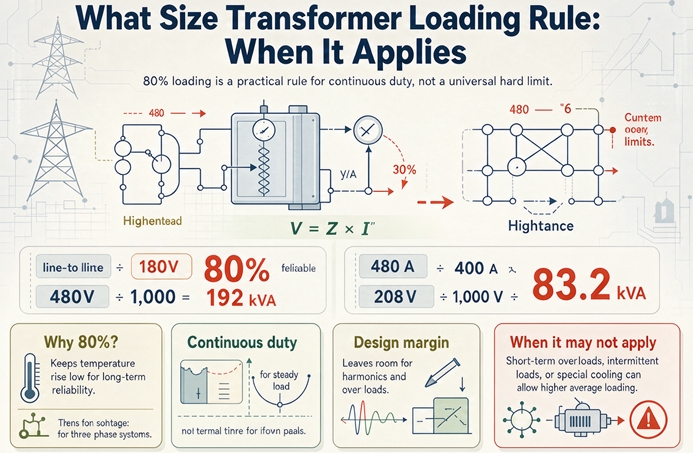
The 80% rule is not in the National Electrical Code, and on a transformer it usually is not even good engineering. It is the inverse of the 125% continuous load multiplier, and that multiplier binds the breaker and the wire, not the iron. Applied to the transformer it gets counted twice. It applies in three places, and none of them is the nameplate.
That is the whole argument, and it takes about ten seconds to check. One divided by one point two five is zero point eight. The number everybody quotes as a margin is not a margin at all. It is the same constant seen from the other end of the same equation, and once you see it that way, a lot of sizing advice stops making sense.
What follows is the arithmetic, the six situations where the number does real work, the four where it does not, and the temperature table that should replace it in almost every case.
Where the number comes from
Start with what the Code actually says, because the Code says one thing and the folklore says another.
A branch circuit feeding a continuous load must have its overcurrent device rated at not less than 125 percent of that load. That is NEC 210.20(A). A feeder gets the same treatment in 215.3, and service-entrance conductors get it in 230.42(A). Three sections, one multiplier, applied to the device and the conductor.
Now turn it around. If the device must be at 125 percent of the load, then the largest load that device can carry is 1 divided by 1.25, which is 80 percent of the device rating. That is the entire origin of the 80% rule. It is not a thermal statement about transformers. It is a statement about breakers.
Run the numbers on real sizes and the point becomes hard to miss.
| Rating | Full load amps at 480 V | 125% for the breaker | 80% of that breaker | As a share of nameplate |
|---|---|---|---|---|
| 300 kVA | 360.8 | 451.1 | 360.8 | 100.0% |
| 500 kVA | 601.4 | 751.8 | 601.4 | 100.0% |
| 750 kVA | 902.1 | 1,127.6 | 902.1 | 100.0% |
| 1000 kVA | 1,202.8 | 1,503.5 | 1,202.8 | 100.0% |
| 1500 kVA | 1,804.2 | 2,255.3 | 1,804.2 | 100.0% |
Every row lands on 100 percent. Of course it does. The two operations are inverse functions, so composing them returns the identity. A transformer protected at 125 percent of full load current, carrying a load that is capped at 80 percent of that device, is carrying exactly its nameplate rating.
Why this is not a coincidence
It is not a coincidence, and it is also not an accident of the numbers. The 125 percent factor exists so the device does not trip at nameplate. A transformer running at exactly its rated current draws exactly its rated current, and a breaker set at 100 percent of that would sit on its own threshold. The 25 percent buys thermal headroom for the breaker, tolerance in the breaker, and the difference between a calculated load and a measured one.
So the 125 percent is not a margin for the transformer. It is a margin for the device protecting the transformer. Reusing it as a transformer margin is a category error, and it is a category error that costs real money once you get past about 500 kVA.
The double count, in one multiplication
Here is the failure, written as plainly as I can.
A 1000 kVA transformer at 480 V carries 1,202.8 amps at nameplate. Its secondary main, per Table 450.3(B), is 125 percent of that, so 1,503.5 amps, and the next standard rating at or above that is 1,600 amps. Note 1 to Table 450.3(B) permits the next higher standard rating when 125 percent does not land on one, and 1,600 is 133 percent of full load, which is the sort of number that makes a plan reviewer look twice but is textually allowed.
Now the load. The largest continuous load that 1,600 amp device can carry is 80 percent of 1,600, which is 1,280 amps. As a share of the transformer’s own 1,202.8 amps, that is 106.4 percent. You have not merely preserved the transformer’s rating, you have exceeded it by 6.4 percent, and you did it by applying two rules that each looked conservative.
Flip the order and it is worse. Apply the 80 percent rule first: 1000 kVA times 0.8 is 800 kVA, which is 962.3 amps. Then size the device for that load at 125 percent, which is 1,202.9 amps, and the next standard rating is 1,600 amps. The device is the same size either way. The conductor is the same size either way. You paid for 1000 kVA and bought 800.
Both of those are the same mistake. The first one gets lucky because of how the rating ladder lands. The second one costs you a size step.
The one line to remember
If you take nothing else from this page, take this: the 80 percent rule and the 125 percent rule are the same rule, and using both is using neither. Pick a side of the equation and stay there. Size the device at 125 percent and load the transformer to 100. Or size the transformer at 1.25 times the load and skip the device arithmetic. Do not do both and then also subtract 20 percent, which is the third version and the one that actually shows up in submittals.
I have seen a specification that required all three: transformer rated 125 percent of calculated demand, secondary device at 125 percent of transformer full load, and continuous loading not to exceed 80 percent of nameplate. Those three clauses, read together, mean the owner pays for 1.95 times the load in transformer capacity. Nobody wrote that down. It emerged from three people each adding a margin.
When the 80% rule does apply
Now the fair half. The number is doing real work in more places than the purists admit, just not where most people think.
| Situation | Does 80% apply | What the number actually is | Source |
|---|---|---|---|
| Continuous load on a branch circuit or feeder | Yes | 125% of the load, so the device sits at 80% of its rating | NEC 210.20(A), 215.3 |
| Service-entrance conductors | Yes | The same 125% factor | NEC 230.42(A) |
| Transformer secondary protection | Yes, but it is the same constant | 125% of full load current, and 80% of that is 100% of nameplate | Table 450.3(B) |
| A utility service agreement or an owner specification | Yes, contractually | Whatever the agreement says, and 80% is common | The contract, not the Code |
| Ambient above the rated basis | Yes, as a curve | 91% at 40 °C, 82% at 50 °C for a 65 °C rise liquid unit | IEEE C57.91, C57.96 |
| Harmonic load on a standard unit | Yes, as a separate derate | A K-factor or a published derate factor | IEEE C57.110 |
| Redundancy, N+1 or 2N | Yes, by design intent | Each unit loaded so the survivor can carry the whole load | Design intent |
| Thermal aging of the insulation | No | It is a temperature, not a percentage | IEEE C57.91 |
Eight rows. Six yes, one qualified, one no. The trouble is that the one no is the row most people are actually asking about.
The contractual 80%, which is the one that really binds
If a specification says the transformer shall not be loaded beyond 80 percent of nameplate, then it shall not, and no amount of thermal analysis will change the submittal. This is where most of the 80 percent rules in the wild actually live. Not in NFPA 70, but in a Division 26 section written by a consultant who has been specifying it that way since 1994.
That is a legitimate decision, and it is worth understanding why consultants make it. The 80 percent number is easy to enforce. A temperature-based criterion requires a load study, a nameplate with a temperature rise class, an ambient record for the room, and somebody willing to sign. A percentage requires a lookup. When you are specifying forty buildings and you have one reviewer, you pick the criterion that can be verified from a photograph of a nameplate.
So the honest advice is not “ignore the 80 percent rule.” It is “know which kind of rule you are dealing with.” A code rule has a section number. A contract rule has a specification section. A rule of thumb has neither, and those are the ones worth arguing about.
The harmonic 80%, which is a different number wearing the same hat
Nonlinear loads push losses above what the nameplate assumes, and IEEE C57.110 is where that gets quantified. A standard K-1 unit serving a K-13 load profile is commonly derated to about 70 percent of nameplate, which means a 500 kVA unit delivers 350 kVA of usable capacity. That is a 30 percent derate, not 20, and it exists for a reason that has nothing to do with continuous loading: eddy current losses in the winding rise with the square of the harmonic current and concentrate at the winding ends.
Two things follow. First, if you have a VFD-heavy bus and you are applying the 80 percent rule, you are probably still undersized, because the harmonic derate is larger and stacks with it. Second, buying a K-rated unit is not a way to escape the derate; it is a way to buy a unit whose nameplate already accounts for it. A K-13 transformer at 100 percent of its K-13 rating is at 100 percent of a rating that was defined for that harmonic spectrum. That is legitimate. A K-1 transformer at 100 percent of its nameplate on the same load is not.
When it does not apply
Four places where the 80 percent rule gets cited and should not.
Article 450 does not set a loading limit
Article 450 of the NEC is titled Transformers and Transformer Vaults. It covers overcurrent protection, grounding, ventilation, vault construction, and installation. It does not contain a maximum loading percentage. Search the article for the number 80 and you will find it in 450.3(A) notes and in the ampacity tables, not as a load limit.
The reason is structural. The Code is a safety document, and the safety question for a transformer is whether it will fail in a way that injures someone, not whether it will deliver its design life. A transformer run at 110 percent for its whole life is a maintenance and asset management problem, not a fire problem, and the Code does not regulate maintenance and asset management.
Loading is governed by IEEE C57.91 for liquid-immersed units and IEEE C57.96 for dry-type. Both are guides, not codes. Neither contains an 80 percent figure. Both define loading categories by temperature.
The efficiency argument is backwards
This is the most common justification and the least defensible. Peak efficiency does not occur at 80 percent. It occurs where no-load loss equals load loss, which is at the square root of the ratio of the two.
For a 1000 kVA unit with no-load loss of 1,500 watts and load loss of 9,000 watts at full load, that ratio is 1,500 divided by 9,000, or 0.1667, and the square root is 0.408. Peak efficiency is at 40.8 percent of nameplate, not 80. The efficiency at that point is 99.19 percent. At 80 percent load it is 99.00 percent. At 100 percent it is 98.85 percent.
The whole curve, from 20 percent load to 100 percent load, spans 98.85 to 99.19 percent. It is 0.34 of a percentage point wide. There is no efficiency argument for 80 percent that survives contact with that number, because the total available prize across the entire operating range is three tenths of a point.
I want to be fair to the people who write this. If your load is 800 kVA, then a 1000 kVA unit at 80 percent load does burn fewer watts than the same unit at 1000 kVA, because the load is lower. But that is a statement about the load, not about the size. Choosing a 1000 kVA unit for an 800 kVA load and then congratulating yourself on 80 percent loading is circular. You did not optimize anything. You just measured the load in two different units.
Fault current does not care how you load it
A transformer’s available fault current is its full load current divided by its per unit impedance. Both of those are nameplate properties. Nothing about them changes when you run the unit at 60 percent instead of 90 percent.
So loading a unit to 80 percent does not reduce the fault current at its terminals, does not let you buy 10 kA switchgear instead of 22 kA, and does not make the arc flash calculation any friendlier. The only thing that changes fault current is the kVA rating and the impedance, which means the way to get lower fault current is to buy a smaller transformer or a higher impedance one, not to load a big one gently.
This matters because a lot of the “headroom” language implies that unused capacity is inert. It is not. The iron is energized and the fault current is available whether you use the capacity or not.
Motor starting stops being the reason above about 750 kVA
Here is the one justification for oversizing that is genuinely physical, and it has a size ceiling nobody mentions.
Voltage dip on motor start is roughly locked rotor current divided by available short circuit current. A 150 hp motor at 1,080 amps locked rotor is a reasonable mid-size industrial load. Put it on a bus fed by transformers at 5.75 percent impedance:
| Transformer | Available fault current | Dip on a 150 hp start |
|---|---|---|
| 500 kVA | 10,459 A | 10.3% |
| 750 kVA | 15,689 A | 6.9% |
| 1000 kVA | 20,918 A | 5.2% |
| 1500 kVA | 31,378 A | 3.4% |
The conventional limit is 10 percent, because NEMA MG 1 builds motors to start at 90 percent of rated voltage and because contactors start chattering below that. At 500 kVA you are right at the line. At 750 kVA you have cleared it. At 1000 kVA a 150 hp start is a 5.2 percent event that no one will notice on a chart.
So motor starting justifies sizing up in the small sizes and stops being an argument somewhere around 750 kVA for motors in the 100 to 200 hp range. If you have a 500 hp motor, the arithmetic moves, and you should run it. But “headroom for motor starting” copied into a specification for a 1500 kVA unit is a justification that has outlived its arithmetic.
For scale: to keep a 150 hp start under 10 percent, you need about 10,800 amps of fault current, which is about 516 kVA at 5.75 percent impedance. That is the size where the argument runs out.
What actually limits a transformer
If it is not a percentage, what is it? A temperature. One temperature, at one point, inside the winding.
A modern North American liquid-immersed distribution transformer is a 65 °C rise unit. That means the average winding temperature rises 65 °C above ambient at rated load, and the hottest point in the winding, which is not the average, rises about 80 °C. Add the conventional 30 °C ambient basis and the hot spot sits at 110 °C at nameplate.
That 110 °C is not arbitrary. It is the reference temperature in IEEE C57.91 where the aging acceleration factor equals 1.0. At that temperature the insulation is consuming life at exactly the design rate, which corresponds to 180,000 hours, or about 20.5 years of continuous operation.
Two equations carry the whole calculation, and they are worth writing out because everything downstream depends on them.
top oil rise:      dTO = dTO_R * ((1 + K^2 * R) / (1 + R))^n
hot spot gradient: dH  = dH_R  * K^(2m)
hot spot:          tH  = tA + dTO + dH

K   = load as a per unit fraction of nameplate
R   = load loss / no-load loss at rated load
n   = 0.8 for ONAN and ONAF, 1.0 for forced oil
m   = 0.8 for ONAN
tA  = ambient temperature
dTO_R = rated top oil rise, 55 C for a 65 C rise unit
dH_R  = rated hot spot gradient, 25 C for a 65 C rise unit
And the aging factor itself:
FAA = exp(15000/383 - 15000/(273 + tH))At a hot spot of 110 °C that expression is exactly 1.0, because both terms are identical. That is the definition, and it is why 110 °C is the reference.
Run it at 30 °C ambient on a unit with a loss ratio of 6, which is typical for a distribution transformer with losses at 0.15 and 0.90 percent of rating:
| Load | Hot spot at 30 °C | Aging rate | Hot spot at 40 °C | Aging rate | Hot spot at 50 °C | Aging rate |
|---|---|---|---|---|---|---|
| 50% | 62.4 °C | 0.00 | 72.4 °C | 0.01 | 82.4 °C | 0.05 |
| 65% | 74.4 °C | 0.02 | 84.4 °C | 0.06 | 94.4 °C | 0.19 |
| 80% | 88.4 °C | 0.10 | 98.4 °C | 0.30 | 108.4 °C | 0.85 |
| 90% | 98.8 °C | 0.31 | 108.8 °C | 0.89 | 118.8 °C | 2.42 |
| 100% | 110.0 °C | 1.00 | 120.0 °C | 2.71 | 130.0 °C | 6.98 |
| 105% | 115.9 °C | 1.80 | 125.9 °C | 4.75 | 135.9 °C | 11.91 |
| 110% | 121.9 °C | 3.26 | 131.9 °C | 8.32 | 141.9 °C | 20.32 |
| 125% | 141.1 °C | 18.90 | 151.1 °C | 44.41 | 161.1 °C | 100.31 |
Read the 30 °C column, because it is the one the rating is defined on.
At 100 percent load the aging rate is 1.00. That is the design point. At 80 percent load it is 0.10, which means the insulation is consuming life at one tenth the design rate. At 65 percent it is 0.02. At 50 percent it is so small the table rounds to zero.
Now think about what 0.10 means. Design life is 20.5 years at a rate of 1.0. At a rate of 0.10 you would get 205 years of insulation life. The tank will rust through, the gaskets will harden, the bushings will crack, and the unit will be scrapped and replaced long before the paper is the limiting item. You cannot bank insulation life against a 25 year old gasket.
That is the argument against using 80 percent as a life extension strategy. Not that it does not extend life. It does, by a factor of ten, and the extension is worth nothing because something else fails first.
Above 100 percent the table turns hostile fast. At 105 percent the rate is 1.80, so a year of operation costs 1.8 years of life. At 110 percent it is 3.26. At 125 percent it is 18.9, which means a single summer at 125 percent costs more life than four years at nameplate.
And note the shape. The curve is nearly flat from 50 to 90 percent and then nearly vertical from 100 to 125. The 80 percent rule sits on the flat part, where moving the number changes almost nothing. The real cliff is at 105, and no rule of thumb warns you about it, because the whole point of a rule of thumb is that it is one number.
The 6 °C rule is a local approximation, and it breaks
You will see the claim that every 6 °C of hot spot halves insulation life. That is the Arrhenius relationship linearized around the reference temperature, and it is accurate over a narrow band. Check it against the table: from 100 to 105 percent load, the hot spot goes from 110.0 to 115.9, which is 5.9 °C, and the aging rate goes from 1.00 to 1.80. Roughly doubled, as advertised.
Now check it from 100 to 125 percent. Hot spot rises 31.1 °C, which by the 6 °C rule should multiply aging by 2 to the power of 5.18, or 36.3. The actual factor is 18.9, about half that. The 6 °C rule overpredicts badly at large excursions because the exponential it is approximating is not that steep at high temperature.
So the 6 °C rule is fine for a five degree conversation and wrong for a thirty degree one. If you are arguing about whether 112 °C is acceptable, use it. If you are deciding whether to run at 125 percent for a summer, use the equation.
The ambient temperature the rule ignores
Now the part that makes the 80 percent rule look less like a conservative choice and more like a coin flip.
The rating is defined at a 30 °C ambient. Change the ambient and the permissible continuous load changes, because the hot spot is an absolute temperature, not a rise. Solve for the load that holds 110 °C at each ambient and you get this:
| Ambient | Maximum continuous load | On a 1000 kVA unit | Amps at 480 V | How far the 80% rule is off |
|---|---|---|---|---|
| 10 °C | 116.5% | 1,164.8 kVA | 1,401.1 A | 36.5 points too strict |
| 20 °C | 108.4% | 1,084.4 kVA | 1,304.3 A | 28.4 points too strict |
| 25 °C | 104.3% | 1,042.7 kVA | 1,254.2 A | 24.3 points too strict |
| 30 °C | 100.0% | 1,000.0 kVA | 1,202.8 A | 20.0 points too strict |
| 35 °C | 95.6% | 956.1 kVA | 1,150.0 A | 15.6 points too strict |
| 40 °C | 91.1% | 910.8 kVA | 1,095.5 A | 11.1 points too strict |
| 45 °C | 86.4% | 864.0 kVA | 1,039.3 A | 6.4 points too strict |
| 50 °C | 81.6% | 815.6 kVA | 981.0 A | 1.6 points too strict |
| 55 °C | 76.5% | 765.1 kVA | 920.3 A | 3.5 points too loose |
This is the heart of the matter. A constant cannot be right about a curve.
In a mechanically cooled electrical room at 20 °C, the transformer can carry 108.4 percent and the 80 percent rule throws away 28 points of capacity for nothing. In a Texas compressor building at 55 °C, the unit can carry 76.5 percent and the 80 percent rule is quietly 3.5 points too generous. The same rule, the same transformer, two opposite errors, decided by a thermometer nobody checked.
Note the slope. It is about 0.9 percent per degree between 30 and 50 °C, which is close to the 1 percent per degree rule of thumb that field engineers have used for decades. If you need a number and you cannot do the equations, 1 percent per degree above 30 °C is a defensible shortcut. It is still a shortcut, but it is a shortcut with the right shape.
Where 80 percent probably came from
I cannot cite a document that introduced the 80 percent rule, and I am not going to invent one. But the arithmetic suggests an origin.
Look at the 50 °C row. The permissible continuous load is 81.6 percent. On a 65 °C rise unit, in a hot climate, at the ambient that used to be the design assumption for outdoor equipment in the southern United States, 80 percent is the right answer to within two points.
Now look at what changed. Modern units are more efficient, which lowers the loss ratio and flattens the curve. Indoor electrical rooms are air conditioned, which drops the ambient to 25 °C or below. The 80 percent number was calibrated for a transformer that no longer exists in a room that no longer exists, and it has been carried forward as if the calibration still held.
That is not a scandal. It is how most rules of thumb age. The useful thing is to know which assumption moved, because that tells you which way to correct.
What to actually ask for
If you are going to replace one number with another, replace it with the three numbers that matter, and put them in the RFQ.
- The temperature rise class. 65 °C rise is the modern North American default. 55 °C rise units exist, are still in service, and have a lower reference hot spot, which means less headroom above nameplate. A 55 °C rise unit quoted against a 65 °C rise specification is a cheaper unit and a different thermal object.
- The rated ambient. Liquid-immersed units are rated on a 30 °C average ambient with a 40 °C maximum. Dry-type units are rated on a 40 °C maximum. If your room runs at 45 °C, the liquid unit is outside its basis and the dry-type is 5 degrees outside its own.
- The loss ratio, meaning the guaranteed no-load and load losses. The loss ratio sets both the peak efficiency point and the shape of the aging curve. Two units with the same kVA and the same impedance can have loss ratios of 4 and 8, and the temperature response differs.
Ask for those three and you can compute your own answer. Accept a kVA number and a percentage and you are trusting somebody else’s thermometer.
The ladder trap between 1000 and 1500 kVA
The 80 percent rule would be a mild inefficiency if transformer sizes came in fine steps. They do not, and the interaction between a coarse ladder and a fixed percentage is where the money goes.
Here is what each standard rating covers under the rule, at 480 V.
| Rating | Load it covers under the 80% rule | Same in amps at 480 V |
|---|---|---|
| 150 kVA | 120.0 to 180.0 kVA | 144.3 to 216.5 A |
| 225 kVA | 180.0 to 240.0 kVA | 216.5 to 288.7 A |
| 300 kVA | 240.0 to 400.0 kVA | 288.7 to 481.1 A |
| 500 kVA | 400.0 to 600.0 kVA | 481.1 to 721.7 A |
| 750 kVA | 600.0 to 800.0 kVA | 721.7 to 962.3 A |
| 1000 kVA | 800.0 to 1,200.0 kVA | 962.3 to 1,443.4 A |
| 1500 kVA | 1,200.0 to 1,600.0 kVA | 1,443.4 to 1,924.5 A |
| 2000 kVA | 1,600.0 to 2,000.0 kVA | 1,924.5 to 2,405.6 A |
Every band is exactly 0.8 times the size step. Where the step is 50 percent, the band is wide. Where the step is 50 percent again, the band is wide. But look at what happens between 750 and 1500.
The step from 750 to 1000 kVA is 33 percent. The step from 1000 to 1500 is 50 percent. Under the 80 percent rule, a 1000 kVA unit covers loads from 800 to 1,200 kVA, which sounds generous until you notice that 1,200 kVA is the load that forces you to 1500 kVA. So the band from 1,000 to 1,200 kVA, a 200 kVA window, has no affordable answer.
Concretely: if your calculated demand is 850 kVA at 480 V, which is 1,022.4 amps, the 80 percent rule tells you to buy 850 divided by 0.8, which is 1,062.5 kVA. There is no such unit. The next standard size is 1500 kVA. You just paid 50 percent more kVA to obtain a 20 percent margin.
And that 850 kVA load is 85 percent of a 1000 kVA unit. It is inside nameplate. It is inside the thermal limit with room to spare, as the aging table shows. The rule moved you up a step and a half, not a step.
Why the step from 1000 to 1500 is the expensive one
Three things happen when you go from 1000 to 1500 kVA, and only one of them is the price of the transformer.
The first is the price of the transformer, which is roughly proportional to kVA for units in the same family, so call it 50 percent more.
The second is the fault current, which goes up by 50 percent as well, because fault current is full load current divided by impedance and the impedance percentage does not change much with size. The consequence is a gear class jump, and that is the subject of the next section.
The third is the physical size. A 1500 kVA unit needs a bigger vault, a bigger door, a bigger pad, and a bigger rigging plan. Those are not line items on the transformer quote. They are line items on the construction budget, and they arrive later, when it is expensive to change.
The second one is the one that surprises people.
What upsizing does to fault current and gear class
Fault current at the transformer secondary is full load current divided by per unit impedance. Nothing else, in the first approximation.
| Unit | Impedance | Fault current | Equipment class needed | Margin |
|---|---|---|---|---|
| 1000 kVA | 5.75% | 20,918 A | 22 kA | 5.2% |
| 1000 kVA | 4.00% | 30,070 A | 42 kA | 39.7% |
| 1500 kVA | 5.75% | 31,378 A | 42 kA | 33.9% |
| 1500 kVA | 4.00% | 45,105 A | 65 kA | 44.1% |
Two things to notice.
First, the 1000 kVA unit at 5.75 percent already sits at 20,918 amps, which is 5.2 percent under the 22 kA rating. That is a tight margin, tighter than the plus or minus 7.5 percent impedance tolerance the unit is allowed, which means a unit that tests at the low end of tolerance can exceed 22 kA. That is a separate problem, covered in more detail elsewhere, but it belongs here too because it shows how little room is left at 1000 kVA.
Second, going to 1500 kVA at the same impedance takes you to 31,378 amps. That is not a 50 percent increase in a number on a drawing. It is a change of product line. Switchboards rated 22 kA and switchboards rated 42 kA are different catalogs, different lead times, different physical sizes, and different prices, and the difference applies to every panel downstream, not just the main.
So the 80 percent rule, applied at 1000 kVA, can cost you 42 kA gear throughout a building. That cost never appears on a transformer quote comparison, because it is not a transformer cost. It appears in the switchgear package three months later, and by then the transformer is ordered.
The impedance lever nobody pulls
Look at the second row again. A 1000 kVA unit at 4.0 percent impedance produces 30,070 amps. The same kVA at 5.75 percent produces 20,918. The kVA is identical. The gear class is not.
If you need more capacity but cannot afford the gear, the answer is sometimes a higher impedance rather than a bigger transformer. Going from 5.75 to 6.5 percent on a 1500 kVA unit cuts fault current from 31,378 to 27,757 amps, which is still above 22 kA and does not save you. Going from 5.75 to 7.0 percent on a 1000 kVA unit cuts it from 20,918 to 17,183 amps, which buys margin under 22 kA but does not change the class.
The lever works better in the other direction, and that is the point. A specification that says “impedance 5.75 percent nominal” without a tolerance band is giving away gear class for free. A specification that says “impedance not less than 5.75 percent, guaranteed, with the factory test report before switchgear release” is buying certainty for the price of a clause.
What it does to wire and breakers, which is nothing
Here is a place where people expect a saving and there is none.
Conductor ampacity for a continuous load is 125 percent of the load, per 215.2(A)(1) for feeders and 210.19(A)(1) for branch circuits. That factor attaches to the load. It does not attach to the transformer, and it does not get smaller because you bought a bigger transformer.
Take the 850 kVA example, which is 1,022.4 amps at 480 V. The conductor needs 1,278 amps of ampacity. In copper at 75 °C, three runs of 600 kcmil give you 1,260 amps, which is 18 amps short, and 240.4(C) removes the next size up allowance above 800 amps, so you cannot round up to a 1,300 amp device. You go to three runs of 750 kcmil at 1,425 amps.
Now buy the 1500 kVA unit that the 80 percent rule demanded. The load is still 1,022.4 amps. The conductor still needs 1,278 amps. The wire is the same three runs of 750 kcmil. The only thing that changed is that you now have a 1500 kVA transformer with a 1,022.4 amp load on it, which is 56.7 percent loaded, and you spent the difference on iron.
Eighteen amps. That is the whole margin between three runs of 600 and three runs of 750 on a 1,022 amp load. It is the kind of detail that does not show up in a sizing calculator and does show up in a bid.
The one sizing number that does scale with the transformer
The secondary overcurrent device does scale, but in the wrong direction for the argument. A bigger transformer needs a bigger device to protect it, which means a bigger frame, which means a bigger enclosure. In the 1000 to 1500 kVA jump, the device goes from 1,600 amps to 2,500 amps, and 2,500 amp frames are a different physical class from 1,600 amp frames. The 80 percent rule does not save you a device. It buys you a larger one.
The efficiency argument, checked
I want to spend a section on this because it is the most repeated and least examined justification.
The claim is that transformers run most efficiently at 80 percent load. The physics says peak efficiency is where no-load loss equals load loss, which is at the square root of the loss ratio.
For the 1000 kVA unit with 1,500 watts of no-load loss and 9,000 watts of load loss, that is 40.8 percent. Here is the curve.
| Load | Efficiency at 0.9 power factor | Total losses |
|---|---|---|
| 20% | 98.98% | 1,860 W |
| 30% | 99.15% | 2,310 W |
| 40.8% | 99.19% | 2,998 W |
| 50% | 99.17% | 3,750 W |
| 65% | 99.10% | 5,302 W |
| 80% | 99.00% | 7,260 W |
| 90% | 98.93% | 8,790 W |
| 100% | 98.85% | 10,500 W |
Peak is at 40.8 percent, and the total variation from 20 to 100 percent load is 0.34 of a percentage point. The difference between 80 percent and 100 percent is 0.15 of a point, which on this unit is 3,240 watts, or about 28,400 kWh a year, or about 2,840 dollars at 10 cents.
That sounds like an argument for 80 percent until you notice what it is actually comparing. It is comparing a unit carrying 800 kVA against the same unit carrying 1,000 kVA. It is not comparing two transformer sizes. The 3,240 watts is the cost of the extra 200 kVA of load, and you would pay it with any transformer.
What happens when you actually compare two sizes
Take an 800 kVA load and put it on a 1000 kVA unit, then on a 1500 kVA unit, with losses scaled at 1,500 and 9,000 watts for the 1000 and 2,250 and 13,500 watts for the 1500.
The 1000 kVA unit runs at 80 percent load and burns 7,260 watts. The 1500 kVA unit runs at 53.3 percent load and burns 6,090 watts. The bigger transformer burns 1,170 watts less, which is about 10,250 kWh a year, or about 1,025 dollars at 10 cents.
That is the opposite of the folklore. Why does it happen? Because the load loss falls with the square of the load fraction while the no-load loss only rises linearly with size. At 53 percent load the 1500 kVA unit’s load loss is 13,500 times 0.284, or 3,840 watts, while the 1000 kVA unit at 80 percent is 9,000 times 0.64, or 5,760 watts. The bigger unit’s load loss advantage more than covers its no-load penalty.
The crossover for a 1.5 to 1 size step with a 1.5 to 1 loss step is at 50 percent of the smaller rating, which is 500 kVA. Below 500 kVA the 1000 kVA unit wins on losses. Above it, the 1500 wins.
This does not rescue the 80 percent rule. It does something more useful: it tells you the rule’s real cost is capital and fault current, not energy. Oversizing a transformer in the 50 to 90 percent band does not waste electricity in any way you can measure. It wastes money on the purchase and it raises the fault current, and those are the two things to argue about.
The one place oversizing genuinely wastes energy is severe underloading, meaning below about 30 percent. A 1500 kVA unit carrying a 200 kVA load burns 2,250 plus 13,500 times 0.0178, which is 2,490 watts, against a 500 kVA unit that would burn about 750 plus 4,500 times 0.16, which is 1,470 watts. There the small unit wins by a kilowatt. That is a real case, and it is a case for not buying a transformer three sizes too big, not for buying one size too big.
Dry-type and liquid-filled do not share a basis
Everything above assumed a liquid-immersed unit rated at 65 °C rise on a 30 °C ambient. Dry-type is a different animal and the difference matters for the 80 percent question.
| Item | Liquid-immersed | Dry-type |
|---|---|---|
| Loading guide | IEEE C57.91 | IEEE C57.96 |
| Rated ambient basis | 30 °C average, 40 °C maximum | 40 °C maximum |
| Typical temperature rise | 65 °C | 150 °C, 115 °C, or 80 °C |
| Hot spot at rated load | 110 °C | depends on rise class, up to about 220 °C |
| Thermal time constant | hours | minutes |
| Overload tolerance | substantial, oil carries heat | limited, winding has little mass |
The rated ambient is the item that changes the answer. A dry-type unit is rated at 40 °C ambient, not 30. So a 150 °C rise dry-type sitting in a 25 °C electrical room is already 15 degrees below its basis, which means it can carry more than nameplate before it reaches its design hot spot. Applying an 80 percent cap to that unit in that room is compounding two conservative assumptions into a very expensive one.
Conversely, a dry-type unit in a 45 °C room is 5 degrees above its basis and genuinely needs a derate. IEEE C57.96 gives the curves.
The thermal time constant difference is the other thing to know. Oil has mass and circulates, so a liquid unit absorbs a short overload by heating a large volume slowly. A dry-type winding is a small mass with air on one side, so it responds in minutes. That is why dry-type units are less forgiving of repeated short overloads even though their hot spot limit in absolute terms is much higher. A 220 °C Class 220 hot spot sounds generous next to 110 °C, and it is not, because the insulation class is different and the time to get there is short.
The service factor that does not exist
You will see transformer literature quoting a 1.15 service factor. That number belongs to motors. A motor with a 1.15 service factor can run at 115 percent of nameplate horsepower continuously under defined conditions.
Transformers do not work that way. There is no service factor on a transformer nameplate. What is on the nameplate is kVA, voltage, impedance, temperature rise, rated ambient, and insulation class. Any allowance above nameplate comes from the loading guide, which means it comes from a temperature calculation, which means it depends on your ambient and your load cycle.
If a supplier tells you their unit has a 1.15 service factor and therefore can carry 115 percent, ask which standard defines it and what ambient it assumes. The answer is usually that they are quoting a motor convention into a transformer conversation.
One worked example, 850 kVA in a 38 °C room
Abstract arguments are easy to nod at. Here is the decision, made twice, on a real shape of problem.
The situation: a plant with a measured 12 month demand of 850 kVA at 480 V, which is 1,022.4 amps. The electrical room runs at 38 °C in August because it has a louver and a fan, not a unit. Load is growing about 6 percent a year. There is one transformer and no spare.
Route one, the 80 percent rule. 850 divided by 0.8 is 1,062.5 kVA, and the next standard size is 1500 kVA. Fault current at 5.75 percent is 31,378 amps, so the switchgear is 42 kA. The unit runs at 56.7 percent load, hot spot 75.5 °C, aging rate 0.02. The 1500 kVA frame needs a bigger vault and a bigger door.
Route two, the thermal limit. At 38 °C the permissible continuous load is 92.9 percent, so a 1000 kVA unit can carry 929.1 kVA. The load is 850, which is 91.5 percent of that allowance. Hot spot at 850 kVA and 38 °C is about 101.5 °C, aging rate 0.41, which means the insulation is consuming life at 41 percent of the design rate. Fault current at 5.75 percent is 20,918 amps, so the switchgear is 22 kA.
Route two is inside every limit. It is 8.5 percent below the thermal ceiling, it is at 41 percent aging, and it keeps the gear at 22 kA. It also has 3.1 percent of growth headroom left after one year at 6 percent, which means the load crosses 929 kVA in about 18 months.
That last number is the honest argument for buying up, and it has nothing to do with the 80 percent rule. You are not buying margin for the transformer. You are buying time.
Route three, which is the one I would actually quote. A 1000 kVA unit with one stage of forced cooling, which typically adds 25 to 33 percent to the nameplate. Now the same frame has a nameplate around 1,250 kVA and a thermal ceiling at 38 °C of about 1,161 kVA, which takes the 6 percent growth curve from 18 months to about 4 years, on 22 kA gear, in the existing vault. Fans need control power, need a failure mode that does not surprise anyone, and need to be on the maintenance list. They cost a fraction of the step to 1500 kVA.
The 80 percent rule cannot produce route three, because it only knows how to multiply by 1.25. It has no vocabulary for fans, for ambient, or for the difference between a nameplate and a thermal limit.
The RFQ that follows from this
Whatever route you take, the RFQ should carry five items, and none of them is a percentage.
- Measured demand, not connected load. Twelve months of interval data, or a 30 day recording, per the method in 220.87. Connected load plus a diversity guess is how you end up arguing about 80 percent of a number nobody measured.
- Room ambient, summer, at the transformer intake. Not the outdoor design temperature. The air the unit actually breathes.
- Temperature rise class and rated ambient. 65 °C rise on 30 °C for liquid, or the dry-type rise class on 40 °C.
- Guaranteed no-load and load losses. Not typical values. Guaranteed, with a tolerance, because these set the aging curve and the efficiency point.
- Impedance with a tolerance and a test report. Because impedance sets the gear class, and the gear class is where the 80 percent rule’s hidden cost lands.
Add a sixth if harmonics are present: the K-factor or the harmonic spectrum, per IEEE C57.110.
Six things that go wrong
In rough order of how much they cost.
- Applying 125 percent and 80 percent to the same transformer. Covered above. You either size the device at 125 percent of full load and load to 100, or you size the unit at 1.25 times the load and skip the device arithmetic. Doing both and then subtracting another 20 percent is how an 850 kVA load becomes a 1500 kVA purchase.
- Reading a nameplate ambient as an outdoor temperature. A liquid unit rated on a 30 °C average ambient in a room that hits 45 °C in August is running outside its basis every summer, and no percentage on a drawing will tell you that.
- Buying the 42 kA gear by accident. The step from 1000 to 1500 kVA at the same impedance takes fault current from 20,918 to 31,378 amps. The transformer quote does not show this. The switchgear quote does, three months later.
- Using the 6 °C rule at a 30 °C excursion. It roughly doubles aging for every 6 degrees near 110 °C and overpredicts by a factor of two at 141 °C. Use it for small arguments and use the Arrhenius form for big ones.
- Quoting a 1.15 service factor on a transformer. That is a motor convention. The transformer equivalent is a temperature calculation, and it needs your ambient and your load cycle.
- Sizing to connected load and then applying 80 percent to the result. Two conservative errors do not cancel. They compound, and the purchase order carries both.
Every one of these is checkable in an afternoon with a nameplate, a thermometer, and a calculator. None of them requires a study
FAQ
Is the 80% transformer loading rule in the NEC?
No. The National Electrical Code contains a 125 percent multiplier for continuous loads in 210.20(A), 215.3, and 230.42(A), and a 125 percent factor for transformer overcurrent protection in Table 450.3(B). The 80 percent figure is the arithmetic inverse of 1.25. Article 450 governs protection and installation, not loading.
What is the difference between the 80% rule and the 125% rule?
They are the same constant applied to opposite sides of one equation. 1 divided by 1.25 is 0.8. Use 125 percent when sizing the breaker or the conductor, and 80 percent when back calculating the largest load a given device can carry. Applying both to the same transformer counts the constant twice and returns 100 percent of nameplate.
Can a transformer run at 100% load continuously?
Yes, at its rated ambient. A 65 °C rise liquid unit at 30 °C ambient reaches a 110 °C hot spot at nameplate, which is the IEEE C57.91 reference where the aging factor is exactly 1.0 and design life is 180,000 hours. Above that the aging rate climbs quickly, but nameplate itself is a design point, not a limit.
When does the 80% rule actually apply?
Four places. Continuous load calculations for branch circuits and feeders under 210.20(A) and 215.3. A specification or utility agreement that names 80 percent contractually. Ambient above the rated basis, where the real derate is 91 percent at 40 °C and 82 percent at 50 °C. And harmonic loads on standard units, where IEEE C57.110 derates are larger still.
What size transformer do I need for 800 kVA?
A 1000 kVA unit if your room runs near 30 °C, because 800 kVA is 80 percent of nameplate and inside the thermal limit. The 80 percent rule would send you there too, for the wrong reason. At 40 °C ambient the ceiling drops to 91 percent of nameplate, which is 911 kVA, still above 800.
What size transformer carries 1,000 amps at 480 V?
About 831 kVA, so a 1000 kVA unit at 83 percent load. At 38 °C ambient a 1000 kVA unit can carry 929 kVA, so 1,000 amps leaves 12 percent of thermal headroom. A 1500 kVA unit would run at 55 percent and change the switchgear class from 22 kA to 42 kA.
How much does loading a transformer to 110% shorten its life?
Substantially. At 30 °C ambient the hot spot goes from 110.0 °C to 121.9 °C and the aging acceleration factor from 1.00 to 3.26. A year at 110 percent consumes about 3.3 years of insulation life. At 125 percent the factor is 18.9, so a single summer costs more life than four years at nameplate.
Does the 80% rule reduce fault current?
No. Available fault current is full load current divided by per unit impedance, and both are nameplate properties. Loading a unit to 60 percent instead of 90 percent changes nothing at the terminals. Only the kVA rating and the impedance move that number, which is why upsizing from 1000 to 1500 kVA takes fault current from 20,918 to 31,378 amps.
How do I derate a transformer for high ambient temperature?
By temperature, not by a fixed percentage. For a 65 °C rise liquid unit the permissible continuous load is about 100 percent at 30 °C, 91 percent at 40 °C, 82 percent at 50 °C, and 77 percent at 55 °C. The slope is roughly 0.9 percent per degree, close to the 1 percent per degree rule of thumb. IEEE C57.96 gives the dry-type curves.
Is a bigger transformer less efficient at part load?
Not necessarily, and often the reverse. Peak efficiency is at 40.8 percent for a 1000 kVA unit with a 6 to 1 loss ratio, not at 80. For a 1.5 to 1 size step with a 1.5 to 1 loss step, the two loss curves cross at 50 percent of the smaller rating, so an 800 kVA load burns 1,170 fewer watts on a 1500 kVA unit than on a 1000 kVA one.
Does the 80% rule apply to dry-type transformers?
Dry-type units are rated on a 40 °C maximum ambient, not 30 °C, and loading is governed by IEEE C57.96 rather than C57.91. In a 25 °C electrical room a 150 °C rise dry-type is already 15 degrees below its basis, so an 80 percent cap there is compounding two conservative assumptions. In a 45 °C room it genuinely needs a derate.
Can I run a transformer at 125% for a few hours?
Mechanically yes, and it will not fail that afternoon. Thermally it costs. At 30 °C ambient a 125 percent load puts the hot spot near 141 °C and the aging factor near 18.9, so a few weeks of it consumes years of life. IEEE C57.91 defines the time limits as a function of ambient and preload, not as one number.
Free: Transformer Specification Checklist
The exact RFQ sheet our engineers use — send it and get a quoted proposal within 24h.
Download checklist