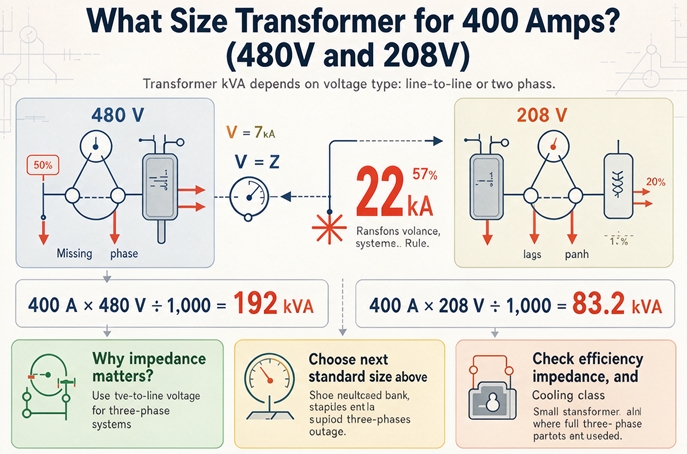
At 480 V three-phase, 400 amps works out to 332.6 kVA, and no standard transformer is built that size. You buy 500 kVA. At 208 V the same 400 amps is 144.1 kVA and fits a 150 kVA. Same current, 2.3 times the iron. The voltage decides. So does one more thing: whether 400 amps is the load or the breaker.
That last point is where most of the sizing advice on the internet quietly fails you. It answers the arithmetic correctly and then hands you the wrong box, because it never asks what the 400 amps actually represents. A 400 amp panel, a 400 amp breaker, and a 400 amp calculated load are three different things, and on a 480 V system they can land you on 300 kVA or 500 kVA, a difference of about 200 kVA of copper and steel.
So let’s do it properly. Start with the table, then earn every row.
The 30-second answer, and the table behind it
Here is every common configuration at 400 amps, with the unit that actually exists and how hard it will be working.
| Configuration | Minimum kVA | Standard size | That unit’s full load amps | Loading at 400 A |
|---|---|---|---|---|
| 400 A at 208 V, 3-phase | 144.1 | 150 kVA | 416.4 A | 96.1% |
| 400 A at 240 V, 3-phase | 166.3 | 225 kVA | 541.3 A | 73.9% |
| 400 A at 480 V, 3-phase | 332.6 | 500 kVA | 601.4 A | 66.5% |
| 400 A at 600 V, 3-phase | 415.7 | 500 kVA | 481.1 A | 83.1% |
| 400 A at 240 V, 1-phase | 96.0 | 100 kVA | 416.7 A | 96.0% |
| 400 A at 480 V, 1-phase | 192.0 | 250 kVA | 520.8 A | 76.8% |
Read the loading column, not the kVA column. Two rows are ugly.
The 208 V row is a tight fit. 150 kVA delivers 416.4 amps, so at 400 amps you are using 96.1% of the unit. That is legal, and it is how thousands of 480-to-208 step-downs are built every year. It also means you have 4% of margin and nothing else.
The 240 V three-phase row is the worst ratio in the table. 400 amps at 240 V is 166.3 kVA, but 150 kVA only gives you 360.8 amps at that voltage, so you jump all the way to 225 kVA to serve a 166 kVA load. That is 58.7 kVA of capacity you did not ask for, and the unit runs at 73.9%. If you are on 240 V delta and wondering why the quote looks expensive, this is why.
And the 480 V row is the one everybody writes about, because 332.6 kVA sits in a hole in the catalog. More on that in a minute.
One note on the table before we go further. These are ANSI/IEEE C57.12.00 preferred ratings, the numbers that show up on a shelf. Three-phase goes 15, 30, 45, 75, 112.5, 150, 225, 300, 500, 750, 1000, 1500, 2000, 2500 kVA. Single-phase goes 15, 25, 37.5, 50, 75, 100, 167, 250, 333, 500, 667, 833 kVA. Two different ladders. Mixing them up is the single most common error in this whole topic, and we will get to it.
Why 400 amps at 480 V lands in a hole
Do the multiplication and you get 332.55 kVA.
Three-phase kVA = 1.732 × 480 × 400 ÷ 1000 = 332.55
Now look for that number on the three-phase ladder. You pass 300 kVA on the way up, and the next rung is 500 kVA. The jump from 300 to 500 is 200 kVA, a 66.7% increase in one step, and it is the widest gap in the entire low-voltage catalog below 1,000 kVA. There is nothing between them. Not 350, not 375, not 400.
So your two candidates are:
- 300 kVA, which delivers 360.8 amps at 480 V. At 400 amps it is running at 110.9%.
- 500 kVA, which delivers 601.4 amps. At 400 amps it is running at 66.5%.
That is the whole problem compressed into two percentages. You are choosing between 111% and 66.5%, and neither of them is 100%. Everything else in this article is about picking between those two numbers with your eyes open instead of by reflex.
Let me also kill the idea that you can order the exact size. You can order a custom 333 kVA three-phase unit. It will not be on the 10 CFR 431.196 efficiency table, because that table is keyed to specific kVA ratings, so there is no efficiency floor it has to meet and no compliance path to point at. It will not be a stocked item anywhere. And the last two quotes I saw for custom low-voltage builds came with 16 to 20 week lead times against 1 to 2 weeks for a standard rating. If you are on a schedule, the hole is not optional. You pick a rung.
What 300 kVA really gives you
360.8 amps. That is 39.2 amps short of 400, or 110.9% loading if you push it there.
Is that allowed? Yes, with an asterisk. The NEC does not cap transformer loading the way it caps conductor ampacity. A transformer is a thermal device, and the IEEE loading guides (C57.96 for dry-type, C57.91 for liquid-filled) give you loading curves rather than a red line. Running 110% through a peak is normal practice on every utility system in the country.
Running 110.9% as a continuous 24/7 number is a different decision. Load loss rises with the square of current, so at 110.9% you are generating 1.23 times the full-load heat (1.109 squared) through the same cooling surface. On an 80 °C or 115 °C rise dry-type, there is room for that. On a 150 °C rise unit in a warm electrical room, you are trading insulation life for kVA, and the trade is not in your favor.
Here is the part that matters more. If the 400 amps came from a panel rating, you are almost certainly not pulling 400 amps.
A 400 amp panel means the bus and the main are rated for 400 amps. It does not mean the connected load is 400 amps. Load a typical commercial panel to its design limit and you land at 80% of the bus, which is 320 amps. At 320 amps on a 480 V system:
1.732 × 480 × 320 ÷ 1000 = 266.0 kVA
266 kVA rounds up to 300 kVA, and 320 amps on a 300 kVA unit is 88.7% loading. That is a well-sized transformer. Not oversized, not undersized, just sized.
Now check the growth room. 300 kVA gives 360.8 amps, you are using 320, so you have 12.7% headroom before you hit nameplate.
Twelve point seven percent is not much. If the tenant adds a kitchen, or somebody wants EV chargers in the parking lot, you are past 100% before the second winter. And here is the arithmetic that should decide it for you:
320 × 1.25 = 400 amps = 110.9% of a 300 kVA unit
Any 25% growth breaks the 300 kVA immediately. Not gradually. One HVAC addition and you are back on the phone with a transformer salesman, except now you are buying a 500 kVA and paying to have the old one removed.
So the honest read on 300 kVA is this: it is the correct unit for a 400 amp panel that will stay a 400 amp panel. It is the wrong unit for a 400 amp panel with a growth plan, and it is the wrong unit for 400 amps of actual load.
What 500 kVA really costs you
601.4 amps, and you are using 66.5% of it.
That means a third of what you paid for is idle. On a dry-type, going from 300 to 500 kVA is the most expensive single step in the low-voltage catalog, because it is a 66.7% capacity increase with no intermediate option. You are buying a 300 kVA job and a half.
Here is what you get for it, and I will defend all four:
Full 400 amps with no argument. At 66.5% loading you can run 400 amps continuously, at 40 °C ambient, with a 150 °C rise unit, and never think about it again. No inspector question, no engineer’s note, no derating worksheet.
88% growth room. 320 amps on a 500 kVA unit is 53.2% loading. You can double the load and stay under nameplate. On a leasehold where the tenant mix is unknown, that is worth real money.
Motor starting margin. This is the one people forget, and it is the only argument here that is about physics rather than paperwork. We will do the numbers in a few sections, but the short version: a 150 hp motor starting across a 300 kVA transformer drops the bus about 17%, and that trips things.
Fault current headroom for the gear you were going to buy anyway. Also counterintuitive. A bigger transformer raises available fault current, which sounds bad, but it also means the switchboard you buy for 22 kA is not marginal. We will get to that, because it cuts both ways.
What you do not get is lower losses. Actually, you might. Hold that thought, we will come back to it with a number, because the usual “oversizing wastes energy” line does not survive contact with this particular load.
Is 400 amps the load or the panel rating?
This is the fork in the road, and it is worth slowing down for.
“400 amps” shows up in three places on a real project, and they mean three different things:
- The bus and main rating of a panel. Capacity, not demand. A 400 amp panel with 180 amps connected is a 400 amp panel.
- A calculated load that got rounded up. Article 220 gives you 372 amps, you spec a 400 amp service because 372 is not a standard rating.
- A 400 amp breaker feeding something you can measure. A chiller plant, a tenant space, an existing service you are re-feeding.
Case 1 and case 3 are the common ones, and they behave very differently from case 2.
The 320 amp ceiling hiding inside every 400 amp breaker
Here is the rule that changes the answer by 200 kVA, and almost nobody applies it to transformer sizing.
NEC 210.20(A) and 215.3 require the overcurrent device to be sized at not less than 125% of the continuous load. Continuous means three hours or more. So a 400 amp breaker, by construction, cannot be carrying more than:
400 ÷ 1.25 = 320 amps of continuous load
That is not a rule of thumb or a design preference. It is the arithmetic consequence of how the breaker got to be 400 amps in the first place. If somebody put a 400 amp breaker on a circuit, the continuous load behind it is 320 amps or less, full stop. Anything above that and the breaker was misapplied.
Run 320 amps through the formula and you get 266.0 kVA, which is a 300 kVA transformer at 88.7%.
A 400 amp breaker is a 300 kVA transformer. That sentence surprises people, and it is correct for any continuous load.
The exception is a noncontinuous load. If the 400 amps is all intermittent (a welder bank, a press line, a test bench), the breaker can be sized at 100% of load, and then 400 amps really is 400 amps, and you really do need 332.6 kVA, and you really are buying 500 kVA.
So the discriminator is not the number. It is one question: is this load continuous?
| If the 400 A is | Continuous? | Real load | kVA at 480 V | Standard size | Loading |
|---|---|---|---|---|---|
| Panel bus rating, normally loaded | mixed | 200 to 320 A | 166 to 266 | 225 or 300 kVA | 74% to 89% |
| Breaker on a continuous load | yes | 320 A max | 266.0 | 300 kVA | 88.7% |
| Breaker on a noncontinuous load | no | 400 A | 332.6 | 500 kVA | 66.5% |
| Calculated load, all continuous | yes | 400 A | 332.6 | 500 kVA | 66.5% |
Two of those four rows land on 300 kVA. Two land on 500. Same “400 amps” going in.
If you take one thing from this article, take that table. It is the difference between a quote that fits and a quote that is 67% too big.
Why the 320 amp ceiling is not a trick
Somebody will read the above and think it is a way to undersize a transformer. It is the opposite. It is a way to stop oversizing one.
If your calculated load really is 372 amps continuous, you do not have a 400 amp breaker. You have a 500 amp breaker, because 372 × 1.25 = 465, and 465 rounds up to 500. The panel is a 500 amp panel. The transformer is 332.6 kVA and you buy 500 kVA. Everything is consistent, and the 320 amp ceiling never comes into it because the breaker was never 400.
The ceiling only applies when the breaker is genuinely 400 amps. And when it is, the load behind it is genuinely 320 or less. There is no gap where a 400 amp breaker carries 390 amps continuously and nobody notices. Either the load calculation was wrong or the breaker is wrong.
The 208 V answer, and why the same amps needs less iron
144.11 kVA, and a 150 kVA unit gives you 416.4 amps.
The reason is embarrassingly simple. kVA scales with voltage. 208 ÷ 480 = 0.433. Multiply 332.55 by 0.433 and you get 144.1. Same current, less than half the apparent power, because each amp is pushing a much smaller voltage.
The ratio works out to 2.31. A 208 V, 400 amp transformer is 2.31 times smaller than a 480 V, 400 amp transformer. Not 2.31 times cheaper, because small units cost more per kVA, but 2.31 times less iron.
The primary side is only 180 amps
This is the part that breaks people’s intuition, and it is worth a paragraph because it comes up in every 480-to-208 conversation.
A 150 kVA transformer at 480 V draws 180.4 amps on the primary. So you are feeding a 400 amp, 208 V panel from a 480 V breaker that is somewhere around 225 amps.
“How can 400 amps come out of 225 amps going in?”
Because the transformer trades volts for amps. 416.4 ÷ 180.4 = 2.308, which is exactly 480 ÷ 208. The watts are conserved (minus a percent or two of loss); the volts are not. If you have ever wondered why a 150 kVA unit has a 4/0 primary feeder and a pair of 300 kcmil secondary feeders, this is the answer, and we will get to those conductor sizes.
The practical consequence: when you spec the 480 V feeder to the transformer, size it on the transformer’s primary current, not on the 400 amps downstream. Getting this backwards produces a wildly oversized feeder and a breaker that will not coordinate with anything.
96.1% loading: legal, and thin
150 kVA at 400 amps is 96.1%. That leaves 4%, which is 16.4 amps.
Is that enough? It depends entirely on whether the 400 amps is continuous, and we already know the answer to that. If the 400 amps is a panel rating with a real load of 320 amps, you are at 76.9% loading and the 150 kVA is perfectly comfortable. If the 400 amps is a genuine continuous load, then 96.1% is what you get and you should be looking at 225 kVA instead.
And there is a code reason to prefer 225 kVA in that second case, not just a comfort reason. A 400 amp continuous load requires conductors at 125%, which is 500 amps. But a 400 amp panel has a 400 amp main. So the panel itself cannot legally carry 400 amps of continuous load. The 400 amp main caps you at 320 amps continuous, same ceiling as before.
Which means: for a 400 amp panel at 208 V, 150 kVA at 76.9% is the right answer, and the “96.1%” scenario only exists for loads your panel cannot serve anyway.
That is a slightly uncomfortable conclusion if you came here expecting a clean “400 amps = 150 kVA.” It is the correct one.
Single-phase 400 amps is a completely different machine
Everything above assumed three-phase. If you are on a single-phase service, the numbers collapse and the ugly mistake appears.
| Single-phase at 400 A | kVA | Standard size | That unit’s amps |
|---|---|---|---|
| 400 A at 120 V | 48.0 | 50 kVA | 416.7 A |
| 400 A at 208 V | 83.2 | 100 kVA | 480.8 A |
| 400 A at 240 V | 96.0 | 100 kVA | 416.7 A |
| 400 A at 277 V | 110.8 | 167 kVA | 602.9 A |
| 400 A at 480 V | 192.0 | 250 kVA | 520.8 A |
Most of these come out smaller than people expect, because single-phase kVA is volts times amps with no 1.732 in it. 400 amps at 240 V single-phase is 96 kVA, which is the classic 400 amp residential or small commercial service, and it runs off a 100 kVA transformer.
The 277 V row is the one that shows how sparse the single-phase ladder is. 400 amps at 277 V is 110.8 kVA, but single-phase goes 100 then 167 with nothing between, so you jump 50.7% to get there. Same trap as 480 V three-phase, worse spacing.
Now the mistake. Watch what happens if you apply the single-phase formula to a three-phase panel:
400 × 208 = 83,200 = 83.2 kVA
vs. the correct 1.732 × 208 × 400 = 144,106 = 144.1 kVA
The error is 42%. You order a 100 kVA, you install a 100 kVA, and it runs at 144% of nameplate the first warm afternoon and trips the primary breaker. This exact error is sitting in a 2007 Mike Holt forum thread where the person asking the question wrote out 400 × 208 = 83.2 KVA and got corrected to 143 kVA. It has been twenty years and people are still making it, which tells you how easy it is.
The tell is simple. If your load is on a three-phase panel, there is a 1.732 in the formula. If your kVA number came out suspiciously close to volts times amps, you forgot it.
One more single-phase wrinkle. A 400 amp, 480 V single-phase load needs 250 kVA, which is half of the 500 kVA three-phase answer for the same amps. That is not a typo, it is what happens when you pull 400 amps from two wires instead of three. Single-phase 400 amp at 480 V is unusual but it exists in irrigation and some welding shops, and it is always more expensive per amp than the three-phase version.
You might not need a transformer at all
Worth thirty seconds, because a surprising number of people searching this question do not actually need to buy one.
The question “what size transformer for 400 amps” only makes sense if you are changing voltage. Four shapes:
480 V in, 480 V out, 400 amps. You do not need a transformer. You need a panel and a feeder. A transformer here would be an isolation transformer, which is a different product with a different justification (separately derived system, drive isolation, K-rated for harmonics).
480 V in, 208Y/120 out, 400 amps at 208 V. This is the classic. 150 kVA, 416.4 amps on the secondary, 180.4 amps on the primary.
208 V in, 480 V out, 400 amps at 480 V. Step-up. 332.6 kVA, 500 kVA unit. Two things bite here: the secondary is often 480 V delta, which is ungrounded unless you corner-ground it, and the inrush on energization is higher relative to the source because you are stepping up from a smaller system. Neither is a sizing problem, both are commissioning problems.
Utility-owned. If the utility owns the transformer, they size it from their own load research, and your 400 amp service gets whatever they decide. Your problem is the service entrance conductors and the metering, not the kVA.
If you are in the first or fourth bucket, close this tab and save yourself a purchase order. If you are in the second or third, keep reading, because the next three sections are where the money is.
The breaker on the primary, and the 1.5 amps per kVA pattern
NEC 450.3(B) governs transformer overcurrent protection at 1,000 V and below. The table says 125% of rated current for the primary of a transformer with a protected secondary, and Note 1 permits the next higher standard rating from 240.6(A) when 125% does not land on one.
That note is where all the interesting decisions live, and there is a pattern in it that will save you a frame size every time.
At 480 V, a transformer’s full load current is 1.2028 amps per kVA. (1,000 ÷ 1.732 ÷ 480 = 1.2028.) Meanwhile, the standard breaker ladder in this range happens to give you exactly 1.5 amps per kVA for 150, 300, and 500 kVA units: 225 A, 450 A, 750 A.
Divide one by the other: 1.5 ÷ 1.2028 = 1.2471.
So on those three sizes, the breaker you would naturally pick sits at 124.71% of full load, which is a hair under the 125% ceiling. You never touch Note 1. You never go up a frame. It just works.
| Transformer | FLA at 480 V | 125% of FLA | Breaker you would pick | Actual % of FLA |
|---|---|---|---|---|
| 150 kVA | 180.4 | 225.5 | 225 A | 124.7% |
| 225 kVA | 270.6 | 338.3 | 350 A | 129.3% |
| 300 kVA | 360.8 | 451.1 | 450 A | 124.7% |
| 500 kVA | 601.4 | 751.8 | 750 A | 124.7% |
| 750 kVA | 902.1 | 1,127.6 | 1,200 A | 133.0% |
| 1,000 kVA | 1,202.8 | 1,503.5 | 1,600 A | 133.0% |
Look at the last column. Three sizes land at 124.7% and three land at 129% to 133%. The difference is whether 1.5 times the kVA happens to be a standard breaker rating. 150 × 1.5 = 225, which is standard. 300 × 1.5 = 450, standard. 500 × 1.5 = 750, standard. But 225 × 1.5 = 337.5, which is not on the ladder, so you go to 350 and land at 129.3%. 750 × 1.5 = 1,125, not on the ladder, so you go to 1,200 and land at 133.0%.
Why 129% is a submittal risk and 124.7% is not
450.3(B) Note 1 permits the next higher standard rating. It does not say how far. Most plan reviewers read it as one rung, which 350 A for a 225 kVA unit is. But a reviewer who reads it strictly will ask you to show that 125% was computed and that no standard rating existed below your number, and then they will want to see the calculation on the drawings.
At 124.7% you never have that conversation. The number is under the ceiling on its own merits.
For this article’s two sizes, that means:
- 300 kVA at 480 V: 450 amp primary breaker, 124.7% of 360.8 A.
- 500 kVA at 480 V: 750 amp primary breaker, 124.7% of 601.4 A.
Not 500, not 800. 450 and 750. If you see a submittal with an 800 amp breaker on a 500 kVA transformer, somebody rounded 751.8 up without checking whether 750 existed.
The secondary side
450.3(B) applies to the secondary too, and here the arithmetic is less forgiving because the ladder spacing is coarser.
- 150 kVA at 208 V: FLA 416.4, 125% = 520.4, use 500 A (120.1%) or 600 A. 500 is under the ceiling, so 500.
- 225 kVA at 208 V: FLA 624.5, 125% = 780.7, use 800 A (128.1%).
- 500 kVA at 480 V: FLA 601.4, 125% = 751.8, use 750 A.
And one trap that costs people the whole point of buying a big transformer: 450.3(B) sets a maximum, not a target. You are allowed to protect at 60%, or 40%, or whatever the load needs. So you can absolutely put a 400 amp main on a 500 kVA secondary.
But then you have bought 601.4 amps of capacity and capped it at 400. That is 66.5% of the unit permanently unreachable, with a breaker that will trip before the transformer is even warm. If your load is 320 amps, buy the 300 kVA and a 400 amp main and save the difference. If you bought the 500 for growth, protect it at 750 and put a 400 amp feeder breaker downstream.
Wire size for 400 amps, at both voltages
Nobody on the first page of results gives you conductor sizes, which is strange, because the wire is often a bigger line item than the transformer terminal block.
The rule is 215.2(A)(1): feeder conductors not less than 125% of the continuous load plus 100% of the noncontinuous load. For a 400 amp continuous load, that is 500 amps of ampacity. Copper, 75 °C terminals, per 310.16:
| Circuit | Required ampacity | Copper conductor, 75 °C |
|---|---|---|
| 400 A continuous load (secondary) | 500 A | 1 × 1,000 kcmil (545 A), or 2 × 250 kcmil (510 A) |
| 400 A noncontinuous load (secondary) | 400 A | 1 × 600 kcmil (420 A) |
| Primary of a 150 kVA at 480 V | 225.5 A | 1 × 4/0 (230 A) |
| Primary of a 300 kVA at 480 V | 451.1 A | 1 × 750 kcmil (475 A) |
| Primary of a 500 kVA at 480 V | 751.8 A | 2 × 500 kcmil (760 A) |
| Secondary of a 150 kVA at 208 V | 520.4 A | 2 × 300 kcmil (570 A), or 1 × 1,000 kcmil (545 A) |
Three things worth noticing.
The 300 kVA primary is a single run of 750 kcmil. That is a big cable but it is one pull, one lug per phase, one conduit. The 500 kVA needs two runs of 500 kcmil, which means two conduits or a much bigger one, twice the lugs, and a pull that takes a crew instead of an electrician. On a lot of jobs the labor difference between these two options is larger than the material difference.
The 1,000 kcmil option is real. A single run of 1,000 kcmil gives 545 amps, which clears the 500 amp requirement for a 400 amp continuous load. One pull instead of two. It is stiff, it needs big bend radius, and terminating it in a small can is an exercise in patience, but it exists and it is often cheaper than two runs.
240.4(C) matters if you go bigger. Over 800 amps, conductors must have ampacity not less than the rating of the overcurrent device, with no next-size-up allowance. The 500 kVA primary at 751.8 amps is still under 800, so you keep the allowance. Cross 800 and the rounding stops.
Grounding is its own article. Short version for a separately derived system: 250.30 governs the system bonding jumper and the grounding electrode conductor, and the equipment grounding conductor on the load side goes by 250.122 sized to the overcurrent device, not to the phase conductors. Do not skip this because the transformer came with a bonding strap.
The fault current bill that comes with 500 kVA
Here is the consequence of the 300 versus 500 decision that nobody puts in the quote comparison.
Available fault current at the transformer secondary is roughly full load amps divided by per-unit impedance. Impedance for low-voltage dry-types in this range is typically 4.0% to 5.75%, so run both ends of the band.
| Transformer | FLA | Isc at 5.75% Z | Isc at 4.0% Z |
|---|---|---|---|
| 300 kVA at 480 V | 360.8 A | 6,276 A | 9,021 A |
| 500 kVA at 480 V | 601.4 A | 10,459 A | 15,035 A |
| 150 kVA at 208 V | 416.4 A | 7,241 A | 10,409 A |
| 225 kVA at 208 V | 624.5 A | 10,862 A | 15,613 A |
Now look at the 10 kA line, because that is the line that changes what you buy.
300 kVA clears it everywhere. Even at the low end of the impedance band (4.0%), you get 9,021 amps. Every panel, disconnect, and breaker rated 10 kA works. That is the cheapest gear in the catalog.
500 kVA does not. At 5.75% you get 10,459 amps, which is 4.6% over the 10 kA rating. At 4.0% you get 15,035, which is 50% over. There is no impedance you can specify at this size that keeps you under 10 kA, because a 5.32% unit (5.75% minus the standard 7.5% tolerance) still gives 11,305.
So the 500 kVA forces 22 kA switchgear. Not as an option, as a requirement.
That is the hidden line item. The 300 kVA lets you buy 10 kA panels throughout the downstream distribution. The 500 kVA means every panel on the secondary has to be 22 kA, and in a building with eight or ten panels that difference is not a rounding error. It is also a different breaker product line with different stocking and different lead times.
And at 208 V it depends on the impedance you get. 150 kVA at 5.75% gives 7,241 amps, comfortably under 10 kA. The same 150 kVA at 4.0% gives 10,409 amps, which crosses the line. So on the 208 V side you must ask for the impedance in writing before you buy the panels, because the same catalog number can go either way.
This is why “impedance” belongs on your RFQ next to “kVA.” It is not a manufacturing detail. It is the number that decides whether your distribution gear is 10 kA or 22 kA.
Motor starting, where the small transformer bites back
Everything so far has argued for the 300 kVA. Here is the case against it, and it is the only argument in this article that is about physics rather than paperwork.
A motor starting across a transformer drops the voltage, because the locked rotor current looks like a near short circuit to the source. First-order estimate:
voltage dip ≈ locked rotor amps ÷ available short circuit current
Take a 150 hp, 460 V motor. Full load 180 amps, locked rotor about 6 times that, so 1,080 amps.
- On a 500 kVA (10,459 A available): 1,080 ÷ 10,459 = 10.3% dip
- On a 300 kVA at 5.75% (6,276 A available): 17.2% dip
- On a 300 kVA at 4.0% (9,021 A available): 12.0% dip
NEMA MG 1 builds motors to start and accelerate their rated load at 90% of rated voltage. So 10% is the working ceiling on a dip, and the 500 kVA is right at it while the 300 kVA is well past it.
At 17%, contactors chatter, VFDs drop out on undervoltage, and the motor may not accelerate at all before the overload trips. You will chase that for a week and then somebody will suggest a soft starter, which costs money you thought you saved.
Two mitigations that change the arithmetic:
A soft starter or VFD. Current-limited start at 200% to 300% of FLA for a few seconds. At 300% of 180 amps, that is 540 amps, and 540 ÷ 6,276 gives a 8.6% dip on the 300 kVA. Suddenly the small transformer works.
Start the big motor first. If the 150 hp chiller is the only large motor and everything else is lighting and receptacles, the dip only matters during that one start, and the rest of the load is not on yet. Sequencing costs nothing.
Now the counter-check, because this cuts both ways. If your 400 amps is mostly lighting, receptacles, and a few small motors, the dip argument evaporates and the 300 kVA is correct. If your 400 amps includes a 150 hp chiller and two 50 hp pumps, you need the 500 kVA, and you needed it for this reason and not for the kVA arithmetic.
Ask what the largest motor is before you pick the transformer. It is a better sizing question than the amps.
The 333 kVA trap
332.55 kVA. 333 kVA. The two numbers are 0.45 kVA apart, which is 0.14%, which is why this mistake has legs.
You will find 333 kVA listed as a standard distribution transformer size on several sizing pages, sitting right next to 250 and 500. It is a real size. It is just not a three-phase size.
Look at the two ladders again:
- Three-phase: 15, 30, 45, 75, 112.5, 150, 225, 300, 500, 750, 1000 kVA
- Single-phase: 15, 25, 37.5, 50, 75, 100, 167, 250, 333, 500 kVA
333 is on the single-phase ladder. There is no 333 kVA three-phase unit in the C57.12.00 preferred ratings, and there is none on a distributor’s shelf.
So when a page tells you to buy a 333 kVA transformer for a 332.6 kVA three-phase load, one of three things happened. They pasted the single-phase ladder into a three-phase context. They confused 333 kVA with a bank of three single-phase units (three 333 kVA singles in a bank gives 999 kVA of three-phase capacity, which is a 1 MVA design, not a 333 kVA design). Or they assumed the catalog goes up in even steps, which it does not.
The practical consequences of ordering one anyway:
No efficiency floor. 10 CFR 431.196 keys its tables to specific kVA ratings. A rating that is not on the table has no compliance path, which means no floor to design to and nothing to point at in a submittal. That is not a legal problem, it is a “you cannot verify what you bought” problem.
No stock. Custom build. The last quotes I have seen ran 16 to 20 weeks against 1 to 2 weeks for a standard rating, and 25% to 35% more money.
No resale. If the project changes, nobody wants your 333.
The correct move when the arithmetic lands on 333 kVA is to decide between 300 and 500 on the merits we have already covered, not to go hunting for a 333.
Efficiency, losses, and the 2029 date
There is a standard line about oversizing: a bigger transformer has higher no-load loss, so the energy bill eats the capital savings. It is true often enough to be repeated, and it is false at this particular load. Let’s do it properly.
Model both units with representative dry-type loss ratios: no-load loss at 0.25% of rating, load loss at 1.2% of rating at full load.
- 300 kVA: no-load 750 W, load loss 3,600 W at 360.8 A
- 500 kVA: no-load 1,250 W, load loss 6,000 W at 601.4 A
Total loss at any current I is no-load plus load loss times (I ÷ FLA) squared.
| Load current | 300 kVA total loss | 500 kVA total loss | Winner |
|---|---|---|---|
| 160 A | 1,458 W | 1,675 W | 300 kVA by 217 W |
| 213 A | 2,005 W | 2,003 W | dead heat |
| 266 A | 2,707 W | 2,424 W | 500 kVA by 283 W |
| 320 A | 3,582 W | 2,949 W | 500 kVA by 633 W |
The two curves cross at 176.8 kVA, which at 480 V is 212.6 amps.
Below 213 amps, the 300 kVA burns fewer watts. Above it, the 500 kVA does. And since a 400 amp panel loaded to 80% sits at 320 amps, the 500 kVA is the cooler unit at that operating point by 633 watts.
At 8,760 hours and 10 cents a kWh, 633 watts is $555 a year. Thirty years at 7% discount, present value factor 12.409, gives about $6,900. That does not close the capital gap between a 300 and a 500, but it is not nothing, and it means you should not justify the 300 on energy grounds. Justify it on capital and on lead time and on the fact that you do not need the capacity.
Two caveats on that table. First, those loss ratios are assumptions, not a specific manufacturer’s data. Ask for the guaranteed no-load and load losses on the bid and rerun it, because a unit with a good no-load number and a mediocre load-loss number can flip the crossover by 50 amps. Second, at light load the 300 wins, so if your building runs at 120 amps most of the year and hits 320 for two weeks, the small unit is the right answer on energy too.
On the compliance side: the 2029 DOE efficiency standards for distribution transformers land on April 23, 2029, from 10 CFR 431.196 as amended at 89 FR 29834 and 90 FR 43371. Both 300 and 500 kVA are on that table with rows for the common BIL ratings, so both are designable and verifiable. If your project energizes after that date, your spec should say “compliant with 10 CFR 431.196 as in effect on the delivery date” rather than naming a year, because the table has moved before and the compliance date is the thing that matters.
One worked example, start to finish
Numbers are easier to trust when you watch them land. Here is a real shape of a job.
A machine shop has a 400 amp, 480 V panel. The Article 220 calculation comes out at 285 amps. The largest motor on the panel is a 75 hp compressor, 96 amps at 460 V per 430.250, locked rotor about 6 times that, so 576 amps. Everything else is lighting, receptacles, and small motors. Ambient in the electrical room hits 40 °C in August.
Step 1, the kVA. 1.732 × 480 × 285 ÷ 1000 = 236.9 kVA. Next standard rung is 300 kVA.
Step 2, the loading. 285 ÷ 360.8 = 79.0%. Comfortable. And 285 amps continuous would need 356 amps of conductor, so the panel feeders are 500 kcmil at 380 amps. Fine.
Step 3, the growth check. Headroom to nameplate is 75.8 amps, which is 26.6%. A second 75 hp compressor at 96 amps puts you at 381 amps, and 381 ÷ 360.8 = 105.6%. So one more compressor breaks it, and that is the point where you decide whether to buy 500 kVA. The honest answer here is “not yet,” because 105.6% during a peak is survivable and the 500 costs more than the compressor.
Step 4, the motor. 576 ÷ 6,276 = 9.2% dip on a 5.75% impedance unit. Under the 10% ceiling, but not by much. If the unit comes in at 4.0% impedance, the fault current rises to 9,021 amps and the dip drops to 6.4%. Both work. The 9.2% case is why you ask for the impedance guarantee rather than accepting “typical.”
Step 5, the primary. 300 kVA at 480 V draws 360.8 amps. Breaker at 125% would be 451.1, and 450 is a standard rating at 124.7%, so 450 amps. Feeder at 451 amps is one run of 750 kcmil at 475 amps.
Step 6, the secondary protection. Transformer secondary is 360.8 amps, 450.3(B) allows up to 451. The panel main is 400 amps, which is under the ceiling and therefore protects the transformer correctly.
Here is the wrinkle worth noticing. The panel says 400 amps on the cover, and the transformer behind it is 360.8 amps. The main breaker is 400. The usable capacity is 360.8. Nobody is lying to you, but if you add 60 amps of load next year because “there’s 115 amps of room in the panel,” you will be running the transformer at 113% and wondering why it smells hot. The panel rating is not the available amps. The transformer is.
Step 7, the fault current. 6,276 amps at 5.75%, 9,021 at 4.0%. Both under 10 kA, so every downstream panel can be 10 kA gear. This is the line item the 500 kVA would have doubled.
Step 8, the losses. At 285 amps the 300 kVA burns 750 + 3,600 × (0.79)² = 2,997 watts. The 500 kVA at the same current burns 1,250 + 6,000 × (0.474)² = 2,598 watts. The big unit is 399 watts cooler. Over a year at 10 cents that is $350, and it does not come close to paying for the extra 200 kVA.
Total: 300 kVA, 450 amp primary breaker, 750 kcmil primary feeder, 400 amp panel main, 10 kA gear throughout. The 500 kVA never enters the conversation, and if a quote comes back with one, the salesperson sized the panel instead of the load.
Six things that go wrong in submittals
These are the ones I see repeatedly, in roughly the order of how much they cost.
- 332.6 rounded to 333 and ordered as a three-phase unit. The unit does not exist, the lead time is 20 weeks, and the submittal comes back rejected on the efficiency table.
- 400 × 208 = 83.2 kVA. Forgot the 1.732. A 42% undersize that will not be caught until the primary breaker trips in July.
- Sized to the panel bus instead of the load. A 400 amp panel with 180 amps connected gets a 500 kVA transformer because 400 amps “needs 500.” You have spent 200 kVA on nothing, and you have also pushed your fault current over the 10 kA line, so the panels cost more too.
- A 500 kVA transformer with a 400 amp main. 66.5% of the unit is permanently unreachable. Either protect it at 750 and feed downstream breakers, or buy the 300.
- Nobody asked for the impedance. So nobody budgeted the 22 kA switchboard, and the first bid comes back with 10 kA gear flagged as noncompliant.
- An 800 amp primary breaker on a 500 kVA. 751.8 rounds to 800 if you do not check the ladder. 750 exists, it is 124.7%, and it is a smaller frame.
Every one of these is a two-minute arithmetic check that did not happen.
What to put on the RFQ
If you are sending this out for quote, put these eleven lines on it. Vague RFQs get vague quotes, and the vagueness always costs you.
- kVA, with the calculated minimum and the selected standard size both stated
- Primary voltage and connection: 480 V delta, 480 V wye, 4160 V, with the connection specified
- Secondary voltage and connection: 208Y/120, 480Y/277, 480 delta, three-wire or four-wire
- Impedance, with a tolerance. Ask for the guaranteed value, not the typical
- Temperature rise: 150 °C, 115 °C, or 80 °C. This drives the physical size and the price
- K-factor if the load is nonlinear: K-4 for general commercial, K-13 for server rooms and drive-heavy shops
- Efficiency compliance: 10 CFR 431.196 as in effect at delivery, and ask for the guaranteed losses
- Taps: typically two above and two below at 2.5% each. Confirm you actually want them
- Enclosure: NEMA 1 indoors, NEMA 3R outdoors, and whether it needs to be ventilated
- Sound level if it is going near occupied space. A 500 kVA dry-type is not quiet
- Mounting and clearance, including the NEC 110.26 working space in front of it
Line 4 is the one people leave off and regret. Everything else is a preference. Impedance is a number that changes what you have to buy downstream.
The bottom line
Four answers, and the one you want depends on a question you may not have asked yourself.
A 400 amp panel at 480 V, loaded normally: 300 kVA. You are at 88.7% on 320 amps, and you have 12.7% growth room.
400 amps of continuous load at 480 V: 500 kVA. 332.6 kVA has no standard size, and the next rung is 500.
A 400 amp panel at 208 V: 150 kVA. 416.4 amps, 76.9% loaded at 320 amps, primary breaker around 225 amps.
400 amps of continuous load at 208 V: 225 kVA, because 150 kVA puts you at 96.1% with no room for the 125% conductor rule.
And the number that decides between the first two: a 400 amp breaker caps continuous load at 320 amps. 320 amps is 266 kVA is 300 kVA. If your 400 amps came off a breaker rather than off a load calculation, you are probably buying a 300, not a 500, and the 500 only earns its place if you have growth, a big motor, or a noncontinuous load that genuinely runs at 400.
Get the impedance, get the largest motor, get the continuity of the load, and the kVA picks itself.
If you are sizing something and the numbers are not landing on a standard rung, send us the load schedule. We size these every week and we will tell you which rung to take and why. Start here
FAQ
How many kVA is 400 amps at 480V?
332.55 kVA for three-phase, using 1.732 × 480 × 400 ÷ 1,000. For single-phase at 480 V it is 192.0 kVA. The three-phase number falls between the 300 kVA and 500 kVA standard ratings, so the next available unit is 500 kVA.
How many kVA is 400 amps at 208V?
144.11 kVA for three-phase, which fits a standard 150 kVA transformer delivering 416.4 amps. For single-phase at 208 V it is 83.2 kVA, which is the number you get if you forget the 1.732, and it is 42% too small.
What size transformer do I need for a 400 amp panel?
Size it to the load, not the bus. A 400 amp panel is normally loaded to about 80%, which is 320 amps, which is 266.0 kVA at 480 V and lands on a 300 kVA transformer at 88.7% loading. At 208 V the same 320 amps is 115.3 kVA and lands on 150 kVA at 76.9%.
Can I use a 300 kVA transformer for 400 amps?
Only if the 400 amps is a panel rating. At a genuine 400 amps, a 300 kVA unit runs at 110.9%, which is a peak number, not a continuous setpoint. It will carry it, and it will age faster doing it.
Why is there no 333 kVA three-phase transformer?
Because 333 kVA is a single-phase rating on the ANSI/IEEE C57.12.00 ladder. The three-phase ladder goes 300 then 500 kVA with nothing between. A 333 kVA three-phase unit would be a custom build with no efficiency table row and a 16 to 20 week lead time.
What size breaker goes on the primary of a 500 kVA transformer at 480V?
750 amps. Full load is 601.4 amps, 125% is 751.8, and 750 is a standard rating at 124.7% of full load, so it satisfies 450.3(B) without needing the next-size-up allowance. An 800 amp breaker also works but is a larger frame for no benefit.
What size wire do I need for 400 amps?
500 amps of ampacity for a continuous load, per the 125% rule in 215.2(A)(1). In copper at 75 °C that is one run of 1,000 kcmil (545 A) or two runs of 250 kcmil (510 A). For a noncontinuous 400 amp load, 600 kcmil (420 A) is enough.
Does a 500 kVA transformer need 22 kA switchgear?
Usually yes. At 5.75% impedance the available fault current is 10,459 amps, which is 4.6% over the 10 kA rating, and at 4.0% it is 15,035 amps. A 300 kVA stays under 10 kA across the whole impedance band, topping out at 9,021 amps.
How much voltage drop will a motor cause when it starts?
Roughly locked rotor amps divided by available fault current. A 150 hp motor at 1,080 amps locked rotor drops a 500 kVA bus by 10.3%, a 300 kVA at 5.75% by 17.2%, and a 300 kVA at 4.0% by 12.0%. NEMA MG 1 builds motors to start at 90% voltage, so 10% is the practical ceiling.
Is a bigger transformer always less efficient at part load?
No, and at this load it is the reverse. With typical dry-type loss ratios the 300 and 500 kVA loss curves cross at 176.8 kVA, which is 212.6 amps at 480 V. Above that current the 500 kVA burns fewer watts, and at 320 amps it burns about 633 W less.
What is the difference between 400 amps at 480V and 400 amps at 208V?
A factor of 2.31 in transformer size. kVA scales with voltage, so the same current at 208 V needs 144.1 kVA where 480 V needs 332.6 kVA. The transformer is smaller, the primary current is 180.4 amps instead of 601.4, and the fault current changes too.
Can I run a 400 amp panel from a 150 kVA transformer at 208V?
Yes, and it is the standard arrangement. 150 kVA at 208 V delivers 416.4 amps, so a 400 amp panel is fed with a 4% margin and runs at 76.9% loading at a realistic 320 amp demand. The 480 V primary draws only 180.4 amps.
Free: Transformer Specification Checklist
The exact RFQ sheet our engineers use — send it and get a quoted proposal within 24h.
Download checklist