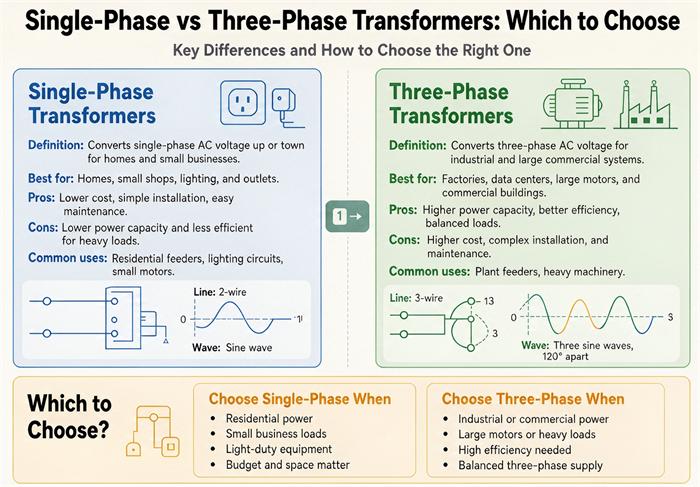
Choose single-phase when the utility feeds your site two wires and the load is lights, outlets, and small equipment under about 50 kVA. Choose three-phase once motors above 5 HP show up or total load passes roughly 167 kVA. The same kVA number means different things in each, so compare amps per phase, not nameplate.
Most buyers get this wrong in the same way. They compare nameplate kVA, see two similar numbers, and assume the machines are comparable. They aren’t. A 75 kVA three-phase unit hands you 25 kVA on each leg. A 75 kVA single-phase unit puts all 75 kVA on one pair of conductors. Different machine, different wire, different protection, different price.
Here’s the decision path, the math behind it, and the code details that decide whether your inspector signs off.
The 60-second answer
Work through these three questions in order. The first one that resolves usually settles it.
- What does the utility actually deliver? Two conductors (one hot, one neutral) means single-phase service. Three or four means three-phase. You can’t invent capacity the utility isn’t sending.
- Is there any real three-phase load? Motors above about 5 HP, chillers, elevators, CNC equipment, UPS and PDU gear. One genuine three-phase load puts you in three-phase territory.
- How big is the total load? Under 50 kVA, single-phase usually wins on simplicity and cost. Past about 167 kVA, three-phase wins on nearly everything.
And the rule that ends most arguments: a single-phase transformer cannot run a three-phase motor. A phase converter can fake it, badly. It adds loss, cuts motor life, and costs more than doing it right.
| Single-phase | Three-phase | |
|---|---|---|
| Utility service needed | 2 wires (1 hot, 1 neutral) | 3 or 4 wires |
| U.S. standard rating ladder | 10, 15, 25, 37.5, 50, 75, 100, 167, 250, 333, 500, 667, 833 kVA | 15, 30, 45, 75, 112.5, 150, 225, 300, 500, 750, 1000, 1500, 2000, 2500 kVA |
| Typical sizes in service | 5 to 167 kVA | 15 kVA up to several MVA |
| Loads it fits | Lighting, receptacles, small HVAC, control circuits | Motors, pumps, compressors, data centers |
| Runs a 3-phase motor? | No | Yes |
| Neutral available? | Yes, center-tapped on 120/240 V | Only on wye secondaries |
| Current for 50 kVA | 208 A at 240 V | 139 A at 208 V, 60 A at 480 V |
| Footprint and weight | Smaller, hand-truckable at small sizes | Larger, needs rigging past a few hundred kVA |
| Upfront cost at small size | Lower | Higher |
| Cost per kVA at large size | Higher | Lower |
What actually changes inside the box
One winding set, or three
A single-phase transformer has one primary winding and one secondary winding on a closed core. Power comes out between two conductors. That’s it. Fewer bushings, fewer connections, one flux path.
A three-phase unit carries three winding sets. Depending on how they’re tied, you get delta (no neutral, handles high current well) or wye (a neutral point, which is what lets you serve 120 V or 277 V line-to-neutral loads from the same unit). The vector group on the nameplate, something like Dyn11, tells you both the connection and the 30 degree shift between primary and secondary. That shift matters the day you parallel two units.
Why three-phase moves more power on less copper
Three-phase power is √3 times line voltage times line current. Single-phase is just voltage times current. That 1.732 factor is the whole economic argument. For the same kVA, three-phase pushes less current through each conductor, so conductors get smaller, losses drop with the square of that current, and one core serves three phases instead of one.
This is why a 500 kVA three-phase unit is smaller and cheaper per kVA than three 167 kVA single-phase units sharing the same total load. Same power, less metal.
The kVA trap: total rating versus per-phase capacity
Print this on the wall. A three-phase kVA rating is a total. Divide by three to get per-phase capacity.
- 150 kVA three-phase = 50 kVA per phase
- 300 kVA three-phase = 100 kVA per phase
- 750 kVA three-phase = 250 kVA per phase
Now the flip side. If you hang a 60 kVA single-phase load on one phase of a 150 kVA three-phase unit, you’ve loaded that phase to 120 percent while the other two sit near idle. The unit is thermally overloaded even though the total is only 40 percent of nameplate. Unbalanced load is the quiet killer in three-phase systems.
This is also why the ÷3 shortcut is useful in reverse. When a vendor quotes a three-phase unit and you need a single-phase equivalent, multiply by three and check whether the result exists on the single-phase ladder. 150 × 3 = 450, which isn’t on the ladder, so you round to 500 kVA. That’s the kind of gap that turns a two week order into a sixteen week special build.
Run the numbers on your own load
Two formulas, no shortcuts
Single-phase: kVA = volts × amps ÷ 1,000. Three-phase: kVA = 1.732 × volts (line to line) × amps ÷ 1,000.
Flip them around to get full load amps, which is what actually sizes your conductors and your breaker.
Same nameplate kVA, very different current
| kVA | Single-phase, 240 V | Three-phase, 208 V | Three-phase, 480 V |
|---|---|---|---|
| 15 | 62.5 A | 41.6 A | 18.0 A |
| 50 | 208.3 A | 138.7 A | 60.1 A |
| 75 | 312.5 A | 208.1 A | 90.2 A |
| 112.5 | 468.8 A | 312.2 A | 135.3 A |
| 150 | 625.0 A | 416.2 A | 180.4 A |
| 225 | 937.5 A | 624.4 A | 270.6 A |
Read the 150 kVA row. Single-phase at 240 V pulls 625 A. Three-phase at 480 V pulls 180 A. Same power, and the three-phase version needs conductors roughly a third the size. On a long run, that difference in copper pays for a good chunk of the transformer.
A worked example: a 100 kVA shop
Say a fabrication shop needs 100 kVA. Two ways to get there.
Single-phase route: 100 kVA at 240 V is 417 A. Copper at 75 °C ampacity means parallel 4/0 conductors, a 400 A frame breaker pushed to the next standard size, and a service that can’t run the 15 HP air compressor’s three-phase motor anyway.
Three-phase route: 100 kVA at 208Y/120 V is 278 A, or 120 A at 480Y/277 V. One 112.5 kVA three-phase unit covers it with headroom, lands on the standard ladder, and runs every motor in the building.
The single-phase route isn’t just bigger. It doesn’t work. That’s the honest answer for most industrial buyers.
One big unit or a bank of three?
This is the question that separates buyers who’ve done it before from buyers who haven’t. Three single-phase units wired together can make three-phase power. Utilities do it on poles all the time. It changes your sparing, your freight, and your failure mode.
The open-delta ceiling: 57.7%, not 66.7%
Wire three identical single-phase units in delta and you get three times one unit’s rating. Lose one, rewire the remaining two in open delta, and most people assume you keep two thirds. You don’t.
Usable three-phase capacity in open delta is √3 times a single unit’s rating, which is 57.7 percent of the closed bank.
Two 50 kVA units, open delta: 1.732 × 50 = 86.6 kVA usable, not 100. The other 13.4 percent of nameplate is tied up circulating reactive power to synthesize the missing phase. Load it to two thirds and the two survivors run at about 115 percent of rating, which is how you cook a winding in a summer week.
What banking really buys you
| One 150 kVA three-phase unit | Three 50 kVA single-phase units | |
|---|---|---|
| Usable capacity | 150 kVA | 150 kVA (closed delta), 86.6 kVA open delta |
| Primary terminations | 3 bushings | 6 bushings |
| Pads and conduit runs | 1 | 3 |
| Protection | One 3-pole device | Three single-pole devices plus coordination |
| Failure mode | Full outage | Lose one, keep 57.7 percent |
| Spare strategy | Spare the whole unit | Spare one 50 kVA can |
| Freight and rigging | One heavy lift, often crane | Three manageable crates |
| Losses | Lower at equal total kVA | Higher, three cores instead of one |
| Best fit | New build, tight footprint, growth planned | Phased growth, remote site, no crane access |
The bank wins when you can’t get a crane to the site, when you’re adding capacity in stages as cash allows, or when downtime matters more than losses. The single unit wins on everything else, including the fact that you only have one nameplate to keep compliant.
If you’re weighing pad layouts and clearances for either approach, the pad-mounted transformer sizing guide covers the physical side in detail.
The neutral, the high leg, and the grounding question
This is where single-phase and three-phase stop being an academic comparison and start causing callbacks.
120/240 V single-phase is a split-phase system. A center-tapped secondary gives you 120 V from either hot leg to neutral and 240 V hot to hot. That’s how a U.S. house runs lights and a dryer off one transformer.
208Y/120 V and 480Y/277 V three-phase are wye systems. You get a neutral, so 120 V receptacles and 277 V lighting work alongside three-phase motors. This is why wye secondaries dominate commercial work.
Delta secondaries have no neutral. A 480 V delta unit cannot feed a 120 V circuit, period. If your panel schedule has receptacle loads and your transformer is delta, you ordered the wrong secondary.
High-leg delta is the trap worth memorizing. On a 240 V center-tapped delta, one leg reads about 208 V to neutral instead of 120 V. Connect a 120 V circuit there and you let the smoke out. The code requires that leg to be marked, conventionally in orange, and the marking requirement lives in NEC 408.3(E). Check it before you land any panel.
Grounding follows NEC Article 250, and which systems must be grounded depends on voltage and whether a neutral is present. Your AHJ has the final word. Don’t let a supplier tell you grounding is a field detail. It changes the transformer’s winding configuration and sometimes the price.
Harmonics deserve a mention too. Three-phase units with a delta winding trap triplen harmonics, which is one reason they handle VFD and rectifier loads better. If your site is mostly drives and switch-mode power supplies, ask about K-rated or derated units. The cooling class guide explains how ONAN and ONAF ratings shift with that extra heat.
Where the money goes over 20 years
Efficiency tables are not comparable across the two columns
Here’s something almost nobody explains. The DOE efficiency table at 10 CFR 431.196 has separate columns for single-phase and three-phase, and they are different rating ladders.
Low-voltage dry-type, 75 kVA: single-phase floor is 98.50 percent, three-phase floor is 98.60 percent. Liquid-immersed, 75 kVA: single-phase floor is 99.19 percent, three-phase floor is 99.03 percent.
So at 75 kVA the single-phase floor is actually higher in the liquid-immersed table. That does not mean single-phase runs cooler in your building. It means the two columns were built from different ladders, different design assumptions, and in the dry-type case a test load at 35 percent of nameplate versus 50 percent for liquid-immersed. Use the table to check compliance for the exact rating you’re buying. Don’t use it to rank the two technologies.
Both tables are on eCFR under 10 CFR Part 431 Subpart K. Note that the amended standards take effect in April 2029, so a unit ordered today with a twenty year life will be judged against a tighter table for most of its service. Confirm the current effective date with your supplier, because the rule has been amended more than once.
A worked 20-year loss example
Take a 75 kVA unit running at 40 percent average load, 8,760 hours a year, at 12 cents per kWh. Output is 30 kW.
At 98.9 percent efficiency, losses are about 334 W. At 98.5 percent, they’re about 457 W. The gap is 123 W, which is 1,077 kWh a year, or roughly $129 at that rate.
Now discount 30 years at 7 percent. Present value factor is 12.409. That $129 a year is about $1,600 in present-day dollars.
$1,600 won’t decide a project. Scale it to a 1,000 kVA unit with a wider efficiency gap and it will. This is also why “cheapest quote wins” is a bad rule: a $2,000 saving at purchase can vanish against $1,600 of losses plus a shorter service life.
The bigger money sits outside the transformer anyway. Conductor size, switchgear count, pad work, and crane time usually dwarf the unit price. That’s the real argument for three-phase at scale, and it’s why the full buying guide puts installation cost ahead of purchase price.
Sizing: pick from the ladder, not a round number
Transformer ratings aren’t continuous. You pick from a ladder, and the two ladders don’t line up.
- Single-phase: 10, 15, 25, 37.5, 50, 75, 100, 167, 250, 333, 500, 667, 833 kVA
- Three-phase: 15, 30, 45, 75, 112.5, 150, 225, 300, 500, 750, 1000, 1500, 2000, 2500 kVA
Notice 45 and 112.5. Buyers who expect a 50 or a 100 kVA three-phase unit get quoted something that doesn’t exist. Notice 167 too, because it’s the top of the practical single-phase range in U.S. distribution practice, and it’s why 167 shows up in every article on this topic.
Then apply the two adjustments that always apply:
- Continuous load: conductors and overcurrent protection sized at 125 percent of continuous load per NEC 215.2 and 215.3. A 180 A continuous draw needs a 225 A conductor, not a 200 A one.
- Growth: most commercial and industrial sites add 20 to 30 percent over the first decade. The step from 225 to 300 kVA costs far less than replacing a 225 kVA unit mid-life.
Add them up and round to the next ladder step. Never round down to a round number you like.
Code notes that decide your inspection
Four numbers cover most U.S. transformer disputes.
NEC 450.3(B) governs primary protection when the primary current is 9 A or more: 125 percent of primary FLA, then the next standard device size. Run it on real units:
| Transformer | Primary FLA | 125% | Device |
|---|---|---|---|
| 167 kVA single-phase, 240 V | 696 A | 870 A | 1,000 A (900 A is not a standard rating) |
| 75 kVA three-phase, 480 V | 90 A | 113 A | 125 A |
| 150 kVA three-phase, 480 V | 180 A | 226 A | 250 A |
| 500 kVA three-phase, 480 V | 601 A | 752 A | 800 A |
That first row is the one that catches people. 870 A rounds up to 900 A in most heads, but 900 A isn’t on the NEC 240.6(A) standard list, so you buy a 1,000 A device. Budget for it early.
NEC 240.4(C) removes the next-size-up allowance above 800 A. Conductors must carry the load, full stop. That’s why large three-phase services jump to parallel runs or busway instead of nudging the breaker up.
NEC 450.3 also requires secondary protection in most configurations, and a three-phase unit needs three-pole devices that open all legs together. Don’t let a panel shop substitute three single-pole breakers.
Nameplate data is your defense. Primary and secondary voltage, kVA, impedance, temperature rise, cooling class, vector group, and the UL listing mark all need to match the submittal before you accept delivery. If you want a field checklist for that, the nameplate reading guide walks through each line item.
For a first pass on which hardware family fits your site, the single-phase cylindrical winding range covers the small end, while dry-type and oil-immersed cover the three-phase side.
Five mistakes that cost the most
- Comparing nameplate kVA across the two types. A 75 kVA three-phase unit is 25 kVA per leg. Load it like a 75 kVA single-phase unit and you’ll trip protection or cook it.
- Forgetting the neutral. Delta secondary, 120 V receptacle schedule. The transformer is fine. Your building isn’t.
- Sizing on kW instead of kVA. A 100 kW motor load at 0.8 power factor needs 125 kVA. Sizing at 100 kVA leaves you 20 percent short before you add anything.
- Ignoring single-phase load on a three-phase unit. A big 120 V load on one leg creates imbalance. Past 5 percent voltage unbalance, motor derating and nuisance trips follow.
- Buying on sticker price. The gap between a compliant unit and a cheap one is usually smaller than the cost of one unplanned outage, one rejected inspection, or one 16 week replacement.
FAQ
Is a three-phase transformer more efficient than a single-phase one? Not by default, and not by the numbers people quote. At 75 kVA low-voltage dry-type, the DOE floor is 98.50 percent for single-phase and 98.60 percent for three-phase. At 75 kVA liquid-immersed it flips: 99.19 percent single-phase against 99.03 percent three-phase. Three-phase wins on total losses at higher capacity because one core serves three phases, but at small sizes the difference is often a fraction of a point. Compare at your real load profile, not on the nameplate.
Can a single-phase transformer run a three-phase motor? No. The output is one phase, and a three-phase motor needs three waveforms 120 degrees apart. A phase converter or a VFD can synthesize the third leg, but you pay in extra losses, reduced motor life, and derating. If a three-phase motor is part of the plan, order three-phase service.
Can three single-phase transformers make three-phase power? Yes, wired in delta or wye. Three identical units in closed delta deliver three times one unit’s rating. Two units in open delta deliver 1.732 times one unit’s rating, which is 57.7 percent of the closed bank, not 66.7 percent. Two 50 kVA units in open delta give you 86.6 kVA of usable three-phase capacity.
What size single-phase transformer does a house need? Most U.S. single-family services land between 15 and 25 kVA. A 200 A service at 240 V works out to 48 kVA if everything ran at once, which it never does. Utilities size on diversified demand, typically 40 to 60 percent of connected load. For a shop or a small commercial building, size from the actual panel schedule instead of a rule of thumb.
How do I tell whether my service is single-phase or three-phase? Count the conductors at the existing transformer or the meter. Two wires means single-phase. Three or four means three-phase. Then check the voltages: 120/240 V is single-phase split-phase, 208Y/120 V or 480Y/277 V is three-phase wye. The utility service letter settles it if the conductors are ambiguous.
What is the largest single-phase transformer I can buy? 167 kVA is the practical top of standard U.S. distribution practice. The DOE table runs to 833 kVA, so larger single-phase units exist, but they’re special builds with long lead times and non-standard protection. Past a few hundred kVA, three-phase is cheaper, smaller, and easier to replace.
Is a three-phase transformer always more expensive? Up front at small sizes, yes. Per kVA at 300 kVA and above, usually no, because one tank, one pad, and one core beat three of everything. The honest comparison includes conductors, switchgear, pad work, and losses. At 50 kVA the single-phase unit usually wins on total cost. At 500 kVA it almost never does.
Free: Transformer Specification Checklist
The exact RFQ sheet our engineers use — send it and get a quoted proposal within 24h.
Download checklist