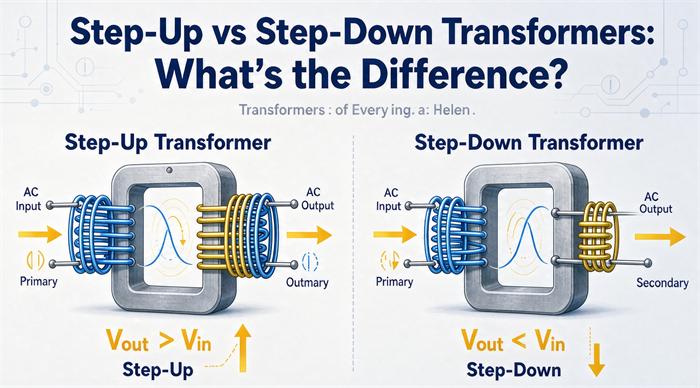
A step-up transformer raises voltage and lowers current by putting more turns on its secondary winding, while a step-down transformer does the opposite, lowering voltage and raising current with fewer secondary turns. Neither one creates power; both move it at about 97 to 99.5 percent efficiency after losses. Pick by direction: step-up feeds long transmission lines and solar or wind export, and step-down feeds buildings, factories, and 480 V or 120 V loads.
The one thing that separates them
Both units are transformers. Same iron core, same Faraday induction, same alternating current only rule. The only structural difference is which winding has more turns. Flip that count and you flip the job.
The power through the unit stays close to constant. Voltage goes up, current comes down. Voltage goes down, current goes up. A 1,000 kVA transformer is a 1,000 kVA transformer whether it steps up or steps down. What changes is the voltage on each side and the current that has to be carried there.
That single fact kills the most common myth in this category. A step-up transformer does not make more power. It trades voltage for current so the same power travels at a level your system can use.
How the turns ratio does the work
Step-up: more turns on the secondary
In a step-up unit the secondary winding has more turns than the primary. The output voltage climbs above the input. You see these on generator outputs, solar and wind collection points, and anything feeding a transmission or sub-transmission line.
Step-down: fewer turns on the secondary
In a step-down unit the secondary has fewer turns. The output voltage falls below the input. This is the workhorse behind every building service, every panel, and almost every wall adapter you have ever owned.
The formula you actually use
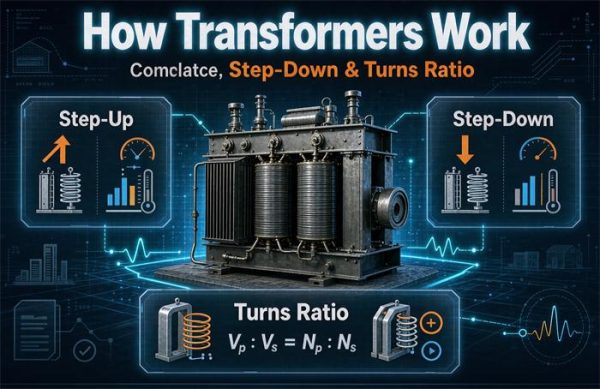
The ratio of turns equals the ratio of voltage:
Ns divided by Np equals Vs divided by Vp
Work a real pair. A 480 V primary feeding a 240 V secondary is a step-down with a turns ratio of 240 over 480, or 0.50. Half the turns, half the volts. Now flip it. A 480 V solar inverter output stepped up to 13,800 V for the utility tie is a step-up with a ratio of 13,800 over 480, or 28.75. The secondary carries 28.75 times the turns and 28.75 times the voltage.
The current moves the opposite way every time, and that is the part that bites buyers who only read the voltage.
What changes on the other side
Current goes the opposite direction
Step-up drops current. Step-down raises it. On a step-down unit the low voltage side can carry several times the high voltage side current for the same kVA, and that low voltage conductor has to be sized for it. A 1,000 kVA step-down from 13.8 kV to 480 V pulls about 42 A on the high side and about 1,204 A on the low side. Ignore that and you buy a transformer the wire cannot feed.
Insulation, clearance, and footprint
Step-up units work at the higher voltage, so the high voltage winding needs more insulation distance and more clearance. Several manufacturers note a step-up unit can run about 20 to 30 percent larger in footprint than a comparable step-down at the same power. Plan the pad or vault before you quote the unit.
Cooling and capacity range
Step-up units sit at the top of the power system, so they often land in the several MVA to hundreds of MVA range and lean on forced cooling at the larger sizes. Step-down units cover the widest spread of any transformer type, from a few volt-amperes in a doorbell transformer up to several MVA in an industrial service. The cooling class you pick tracks the rating, not the direction.
Real voltage pairs US buyers specify
These are the combinations that actually show up on North American specs. The direction column tells you which winding does what.
| Application | Direction | Voltage pair | Why |
|---|---|---|---|
| Solar or wind plant export | Step-up | 480 V or 690 V to 12.47 kV or 13.8 kV | Reach the utility tie at medium voltage |
| Generator step-up (GSU) | Step-up | 13.8 kV to 69 kV, 115 kV, or 138 kV | Push bulk power onto the grid |
| Building service | Step-down | 13.8 kV or 4.16 kV to 480 V | Feed plant distribution |
| Panel and control power | Step-down | 480 V to 208Y or 120 V | Lights, receptacles, controls |
| EV DC fast charge site | Step-down | 13.8 kV or 34.5 kV to 480 V | Supply the charger DC front end |
| Utility distribution | Step-down | 115 kV or 69 kV to 13.8 kV to 4.16 kV | Cascade down to the customer |
If your project is a renewable export, the step-up role and selection write-up walks the medium voltage tie in more detail.
Step-up vs step-down at a glance
This is the table search engines like to lift into a comparison snippet. Keep it scannable.
| Aspect | Step-up transformer | Step-down transformer |
|---|---|---|
| Voltage move | Low to high | High to low |
| Secondary turns | More than primary | Fewer than primary |
| Current move | Decreases | Increases |
| Typical use | Generation, transmission, renewable export | Buildings, factories, panels, electronics |
| Footprint at equal power | Larger, about 20 to 30 percent | More compact |
| Capacity range | Several MVA to hundreds of MVA | Few VA to several MVA |
| Cost trend | Higher insulation and transport cost | Broader, lower cost spread |
Can you run one backwards
Yes, you can swap the input and output terminals and reverse the direction. A step-down used as a step-up will technically work. Do not assume it is a good idea.
Running in reverse often lowers efficiency, shifts the cooling design away from where it was meant to sit, and stresses insulation and winding layout built for the original direction. The unit ages faster and can overheat. If you need reversible duty, spec it that way from the start instead of hoping a standard unit tolerates the swap.
Autotransformers blur the line further because primary and secondary share a winding, but the shared coupling removes the isolation a separate-winding unit gives you. That matters for safety and fault isolation, not just voltage.
Specifying for the US market
Most of the comparison pages out there stop at the physics. For a North American purchase order, the direction is only the first line.
The unit has to meet NEC Article 450 for installation, carry a UL or cUL listing under 1561 or 1562 for the construction type, and meet the DOE distribution transformer efficiency rules under 10 CFR 431, with the 2024 update taking effect on April 23, 2029. Frequency is 60 Hz, full stop. A 50 Hz unit will not run correctly on a 60 Hz system and vice versa, so the nameplate frequency is not a detail you negotiate.
The standards split between IEC and ANSI or IEEE decides how your test reports and ratings read, and which utility will accept the unit. The nameplate guide shows where the ratio, kVA, impedance, and frequency live on the plate so you can confirm the unit before it ships.
Common mistakes when comparing the two
Mistake one is thinking a transformer creates power. It changes voltage and current, not the net wattage. Mistake two is ignoring the current rise on the step-down low voltage side, which drives conductor and breaker sizing. Mistake three is shopping on kVA alone and skipping insulation class, cooling, and duty cycle. Mistake four is assuming all distribution transformers are interchangeable; dry-type, oil-immersed, and sealed units serve different sites. Mistake five is overlooking the standard, because IEEE and IEC compliance affects testability, interchangeability, and which utility will sign off.
What to put in the RFQ
Give your supplier enough to quote the real unit, not a catalog guess. List the input voltage and frequency, the required output voltage, the load in kVA with its profile, the installation environment, the cooling method, the insulation class, the standard and listing, the impedance target, the altitude and ambient, and the quote validity window. A clean routine testing package is the fastest way to tell a real offer from a bare-number come-on. If the quote does not state the guaranteed losses, the standard, and the test scope, you are comparing guesses.
For a dry-type unit, the same spec fields apply, with the added fire-code question of where the unit sits.
FAQ
What is the main difference between a step-up and a step-down transformer? A step-up transformer has more turns on its secondary winding and raises voltage while lowering current. A step-down transformer has fewer secondary turns and lowers voltage while raising current. The input power stays roughly equal after losses.
Does a step-up transformer increase current? No. A step-up transformer raises voltage and lowers current by the same ratio. Power stays near constant, so if voltage climbs by 28.75 times, current falls by 28.75 times on the other side.
Can a step-down transformer be used as a step-up transformer? Yes, by swapping the input and output terminals, but it is not recommended. Reverse operation often lowers efficiency, shifts cooling away from its design, and stresses insulation and winding layout, which shortens life and risks overheating.
What efficiency should I expect from either type? Most distribution and power transformers land between 97 and 99.5 percent efficiency. The gap between a good and a poor unit is the no-load and load loss, which runs every hour the unit is energized and shows up as a lifetime electricity bill.
How do I know which one I need? Decide by voltage direction. If your output must be higher than your input, choose step-up. If your output must be lower, choose step-down. Then match kVA, cooling, insulation class, and the applicable standard to the site.
Are step-up transformers more expensive than step-down units? Often yes at equal power. A step-up unit needs more insulation distance and clearance, can run about 20 to 30 percent larger in footprint, and costs more to build, transport, and maintain. Step-down units span a wider, lower cost range.
What voltage pairs are common in the US? Typical pairs include 480 V to 240 V, 13.8 kV or 4.16 kV to 480 V for building service, 480 V or 690 V to 12.47 kV or 13.8 kV for renewable export, and 115 kV or 69 kV down to 13.8 kV for utility distribution. All run at 60 Hz.
Free: Transformer Specification Checklist
The exact RFQ sheet our engineers use — send it and get a quoted proposal within 24h.
Download checklist