A transformer is a quiet electrical device that changes alternating current (AC) voltage up or down without the wires ever touching, using a magnetic field instead of moving parts. Power plants use big step-up units to push electricity hundreds of miles, and your phone charger uses a tiny step-down one to keep you safe. They run at 97 to 99.5 percent efficiency and sit inside nearly every building and grid you use.
Quick note before we go further. When people type “transformer” in 2026, half the results are about the AI language model. This article is about the electrical device, the metal box that moves power around. Same word, completely different thing.
What a transformer actually is
Think of the power grid as a highway system for electricity. Voltage is like pressure, and current is like traffic volume. A transformer is a rest stop that changes the pressure without stopping the flow. It does not generate electricity. It does not store it. It just reshapes the voltage and current so power travels far without wasting away, then drops to a safe level where you live and work.
The core idea is simple. Electricity in equals electricity out, minus a small loss. If the voltage goes up, the current goes down by the same proportion. If the voltage drops, the current rises. The total power stays close to constant. That trade is the whole job of the device.
Why a transformer only works on AC
A transformer needs a changing magnetic field to do anything. Alternating current naturally flips direction 50 or 60 times a second, so it keeps building and collapsing that field. Direct current sits still, which means no changing field, which means no induced voltage on the other side. Hook a transformer to a battery and you get nothing useful out of the secondary, just a brief blip when you first connect it.
This is why every transformer you buy is rated for a frequency, almost always 50 Hz or 60 Hz. A 60 Hz unit built for North America will not perform correctly on a 50 Hz supply unless the designer planned for it. If your project spans regions, confirm the frequency before you spec the unit.
The three parts every transformer shares
Strip any transformer down and you find the same three building blocks.
| Part | What it does |
|---|---|
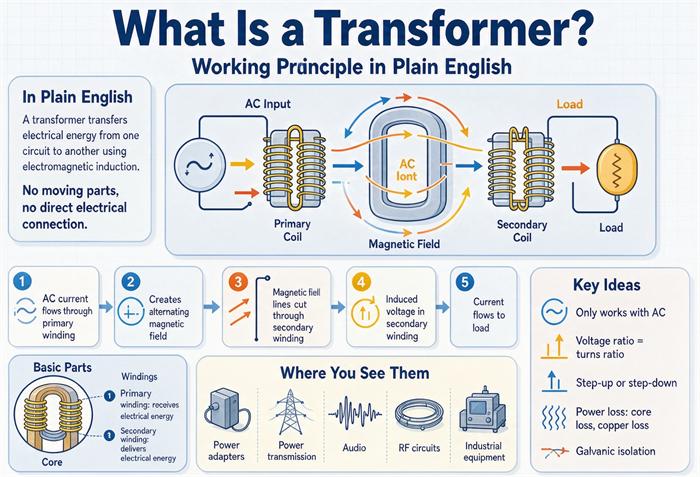
| Primary winding | Takes the incoming AC and creates a changing magnetic field |
| Secondary winding | Sits inside that field and delivers the new voltage to your load |
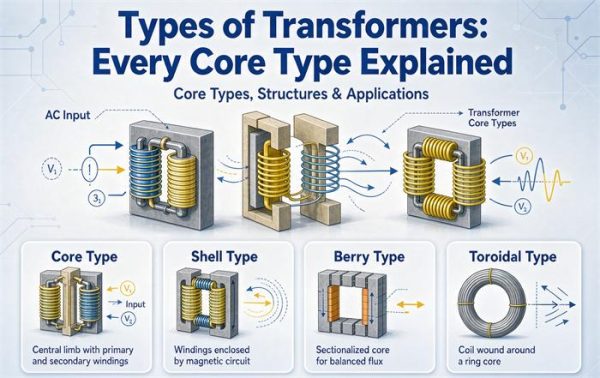
| Core | A steel path that carries the magnetic field between the two windings |
The two windings are not wired together. They are magnetically coupled, not electrically connected. That gap is what gives a transformer its safety benefit. A fault on one side does not automatically travel to the other, and you can isolate circuits by design. The core is laminated steel (or stacked plates) because a solid block would waste energy as heat from internal swirling currents.
How a transformer works, step by step
Here is the plain English sequence you can picture:
- AC flows into the primary winding.
- That current builds a magnetic field in the core.
- Because the current keeps alternating, the field keeps changing.
- The changing field sweeps across the secondary winding.
- A voltage appears on the secondary, ready to feed your equipment.
No gears, no spinning shaft, no contacts opening and closing. The only thing moving is the magnetic field, and that is why a well built transformer can run for decades with almost nothing to wear out. The principle has a name, Faraday’s law of electromagnetic induction, but you do not need the math to trust the result. You see it every time a device powers on.
Step-up vs step-down: it comes down to the turns
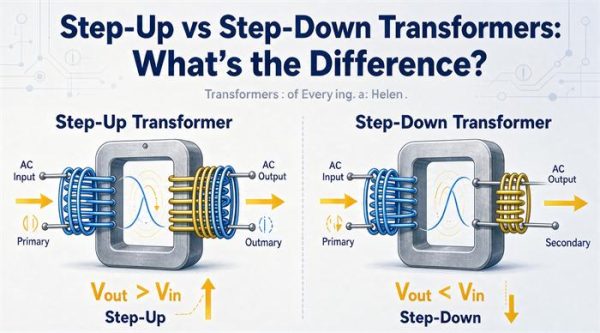
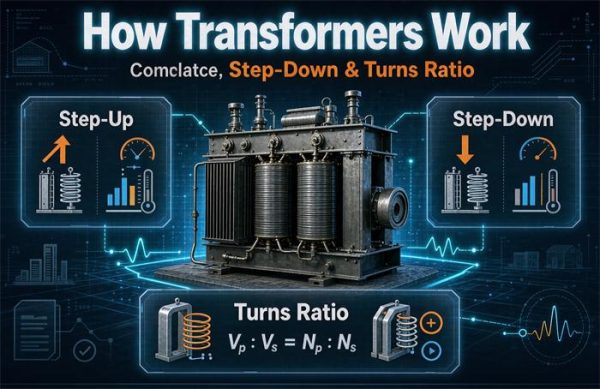
The ratio of wire turns decides everything. More turns on the secondary than the primary gives you a higher voltage out. Fewer turns gives you a lower voltage. The voltage ratio tracks the turns ratio almost exactly.
| Feature | Step-up transformer | Step-down transformer |
|---|---|---|
| Secondary winding | More turns than the primary | Fewer turns than the primary |
| Effect on voltage | Raises it for long hauls | Lowers it for safe use |
| Where you find it | Power plant, solar farm, wind site | Home panel, phone charger, factory floor |
A generator might make power at a few thousand volts. Send that across the country at that level and most of it heats the wires. Step it up to hundreds of thousands of volts and the same power travels with tiny loss. Near your neighborhood, a step-down unit brings it back to 120, 240, or 480 volts. Same device family, opposite job at each end of the line.
The types you will meet as a buyer
Once you move from physics class to a purchase order, transformers split along a few practical lines.
Dry-type vs oil-immersed
A dry-type unit cools itself with air and sits indoors where fire codes matter. An oil-immersed unit bathes its core in mineral or vegetable oil for cooling and insulation, which lets it handle higher voltages and bigger ratings. The choice drives cost, placement, and maintenance for the life of the install. Our guide to dry-type transformers and how to choose one walks the basics, and the dry vs oil comparison lays out where each one wins.
Single-phase vs three-phase
Homes in the US run on single-phase power, so small loads use single-phase transformers. Commercial and industrial sites use three-phase power, which needs three-phase units built to balance the load across three lines. The phase count is not a detail you pick later. It is set by the building you are feeding, so it belongs in the spec from day one.
Efficiency and losses: why 100 percent never happens
A transformer has no moving parts, so it wastes far less than a motor or an engine. But it is not perfect. Two losses always show up. No-load loss, also called core loss, runs all the time the unit is energized, even with nothing connected. Load loss, also called copper loss, grows with the square of the current you draw.
Real distribution and power transformers land in the 97 to 99.5 percent efficiency band, and the loss shows up as heat. That heat is not free. A unit that wastes 1.5 kW around the clock burns roughly 13,000 kWh a year, and at a typical commercial rate that is thousands of dollars over the service life. This is exactly why efficiency standards matter and why a slightly better unit can pay for itself. If you want the cooling side of that story, the cooling classes explainer shows how rating and temperature limits tie together.
Where you already rely on transformers
You are using transformers constantly without thinking about them. The substation down the street steps transmission voltage down to feed your block. The adapter on your laptop is a transformer plus a rectifier in a tiny shell. Solar farms and wind sites use step-up transformers to inject clean power into the grid at the right voltage. Hospitals, data centers, factories, and rail lines all depend on banks of them. Remove transformers and the modern grid stops being modern.
If you are buying one, here is what matters
Reading about the principle is one thing. Specifying a unit is another. The physics stays the same, but the purchase hinges on a short list of ratings.
Rating, voltage, and the nameplate
The number that sizes a transformer is its kVA rating, not its watts. kVA covers the total apparent power, and it tells you how much load the unit can carry without overheating. You also need the primary and secondary voltages, the frequency, the vector group for three-phase units, and the impedance. All of those live on the nameplate, and learning to read it is the fastest way to spot a quote that does not fit your job.
Standards and efficiency rules for the US
For the US market, the relevant rules are not optional. DOE efficiency standards set the floor for many liquid immersed and dry-type distribution transformers, and the compliance date for the updated levels is April 23, 2029. Safety listing through UL (or the Canadian cUL mark) tells you the design passed a recognized test lab. On top of that, utilities and local authorities often add their own specification. The split between IEC and ANSI or IEEE approaches explains why a unit built to one system may need changes to clear the other. Get these wrong and the unit gets rejected at inspection, not at the border.
Mistakes first-time buyers make
A few errors show up again and again.
- Sizing to the motor nameplate instead of the actual load, which buys capacity you will never use.
- Forgetting the continuous load rule, so the unit runs hot from hour one.
- Picking dry when oil was the better long term call, or the reverse, based on price alone.
- Treating the frequency as global when the project is 60 Hz and the spare is 50 Hz.
- Ignoring the efficiency grade because the sticker price looked better, then paying for it in losses for twenty years.
None of these are hard to avoid once you know they exist. They just rarely appear in the basic “what is a transformer” pages, which is why they bite new buyers.
FAQ
What is a transformer in simple terms? A transformer is a device that changes AC voltage up or down using a magnetic field, with no moving parts. It moves power from one circuit to another without the wires touching.
How does a transformer work step by step? AC enters the primary winding and creates a changing magnetic field in the core. That field sweeps the secondary winding and induces a new voltage there. The turns ratio sets whether the output is higher or lower than the input.
Why does a transformer only work with AC? A transformer needs a changing magnetic field, and only alternating current keeps flipping direction to create one. Direct current sits still, so it produces no ongoing induced voltage on the secondary side.
What is the difference between step-up and step-down transformers? A step-up transformer has more turns on the secondary and raises the voltage. A step-down transformer has fewer turns on the secondary and lowers it. Both use the same principle and often sit at opposite ends of the same power line.
What are the main parts of a transformer? Every transformer has a primary winding that receives the input, a secondary winding that delivers the output, and a laminated steel core that carries the magnetic field between them.
What is the efficiency of a typical transformer? Most distribution and power transformers run between 97 and 99.5 percent efficient. The small loss becomes heat, and over a long service life that heat adds up to real energy cost.
Do transformers work on DC or only AC? They work on AC only. A transformer cannot change DC voltage, which is why grid and building power uses alternating current for transmission and distribution.
Bottom line
A transformer is the unsung piece of the power grid. It changes AC voltage using a magnetic field, has no moving parts, and runs at 97 to 99.5 percent efficiency. Understand the turns ratio, the three core parts, and the AC-only rule and you understand the device. Understand kVA, the nameplate, UL or DOE compliance, and the dry vs oil call and you are ready to buy one that actually fits. If your project needs a unit spec’d to the right standard and rating, the team at TransNorth Electric can walk the numbers with you before you commit a budget.
Free: Transformer Specification Checklist
The exact RFQ sheet our engineers use — send it and get a quoted proposal within 24h.
Download checklist