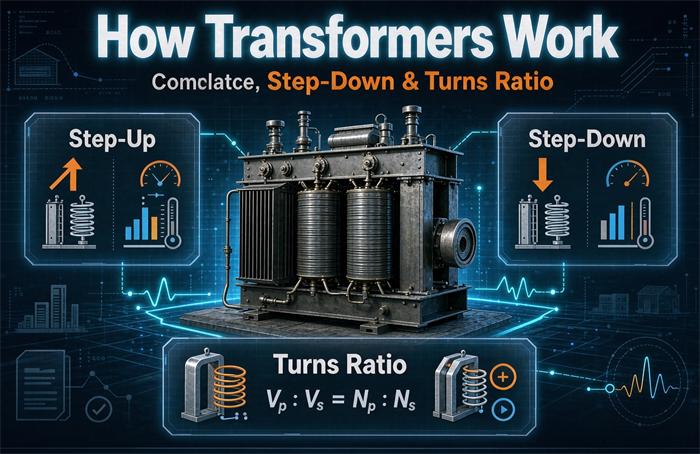
A transformer changes voltage using two coils and a magnetic core. The turns ratio, the number of secondary turns divided by primary turns (Ns/Np), sets the output: a step-up transformer has more secondary turns and raises voltage, while a step-down transformer has fewer and lowers it. Voltage scales with the coil ratio, and current moves the opposite way, so power stays close to constant.
What a transformer actually does
A transformer is a static device. It moves electrical energy from one circuit to another without a direct wire connection between them. It does not spin. It does not make electricity. It only changes the voltage level so power can travel far with low loss, then drop to a safe, usable level at the load.
Most buyers do not need the deep physics. You need three takeaways. First, the transformer only works on alternating current. Second, the voltage change is fixed by the coil ratio, not by a dial. Third, that ratio tells you the voltage, but it says nothing about how much power the unit can handle. We cover that last point because it is the one that trips up specifiers.
The core idea: electromagnetic induction
Here is the whole trick. You feed alternating current into the primary coil. That current builds a changing magnetic field in the iron core. The core carries that field over to the secondary coil. Because the field keeps changing, it induces a voltage in the secondary. No electrons cross from primary to secondary. The energy rides the magnetic field.
Why it only works on AC
Direct current does not change direction, so it makes a steady magnetic field, not a changing one. A steady field induces nothing in the secondary. That is why a transformer humming on a 60 Hz panel goes dead the moment someone feeds it DC. Frequency stays the same on both sides. If you put 60 Hz in, you get 60 Hz out, no matter the voltage.
The turns ratio: the formula that sets your voltage
This is the equation every specifier should know.
Vs / Vp = Ns / Np
Read it plain: secondary voltage over primary voltage equals secondary turns over primary turns. Double the secondary turns and you double the voltage. Halve them and you halve the voltage. The ratio is just the coil count on each side.
Reading the ratio: which side is which
The primary is the side you feed. The secondary is the side that feeds your load. If Ns is bigger than Np, the voltage goes up. If Ns is smaller, the voltage goes down. That single comparison is the entire step-up versus step-down question.
A worked example you can reuse
Say the primary has 100 turns and you apply 480 volts. If the secondary has 50 turns, the output is 480 times (50 / 100), which is 240 volts. That is a step-down unit. Flip it: keep 100 primary turns, wind 200 secondary turns, and the output becomes 960 volts from the same 480 volt input. Same formula, opposite result.
Step-up vs step-down: what changes and what doesn’t
The only thing the ratio changes is voltage. Current moves the other way to keep power roughly equal. Raise the voltage and you lower the current in the same breath.
| Type | Secondary turns | Voltage | Current | Typical buyer use |
|---|---|---|---|---|
| Step-up | More than primary | Increases | Decreases | Solar and wind collection, feeding a higher grid voltage |
| Step-down | Fewer than primary | Decreases | Increases | Substations, plant distribution, 480 V to 240 V loads |
Step-up transformers
A step-up unit has more turns on the secondary. It lifts voltage so power can travel long distances at low current, which cuts line loss. You see them at the output of renewable plants and at generation sites. A 480 V solar array, for example, often steps up to 13.8 kV to reach the grid tie.
Step-down transformers
A step-down unit has fewer secondary turns. It brings high distribution voltage to the level your equipment actually uses. Nearly every building sits downstream of one. The 13.8 kV feeder that enters a site becomes 480 V at the service transformer, then often 240 V or 120 V for final loads.
Real voltage pairs buyers actually specify
These are the conversions procurement teams ask for most. The ratio column is Ns/Np, secondary over primary.
| Input | Output | Ratio (Ns/Np) | Common application |
|---|---|---|---|
| 480 V | 240 V | 0.50 | US industrial motor and lighting feed |
| 208 V | 120 V | 0.58 | US commercial branch circuits |
| 13.8 kV | 480 V | 0.035 | Substation to facility service |
| 480 V | 13.8 kV | 28.75 | Solar and storage step-up to grid |
| 11 kV | 400 V | 0.036 | IEC distribution to plant |
| 35 kV | 10 kV | 0.29 | Medium voltage utility feed |
| 120 V | 240 V | 2.00 | Step-up for specific equipment |
Notice the 13.8 kV to 480 V row. The ratio is tiny because you are dropping a big number to a small one. The 480 V to 13.8 kV row is the same pair run backwards, so the ratio simply inverts. Same iron, opposite job.
Ratio is not the whole spec
This is where the textbook pages stop and the buying decision starts. A correct ratio gives you the right voltage. It does not tell you whether the unit will survive your site.
kVA is capacity, ratio is voltage
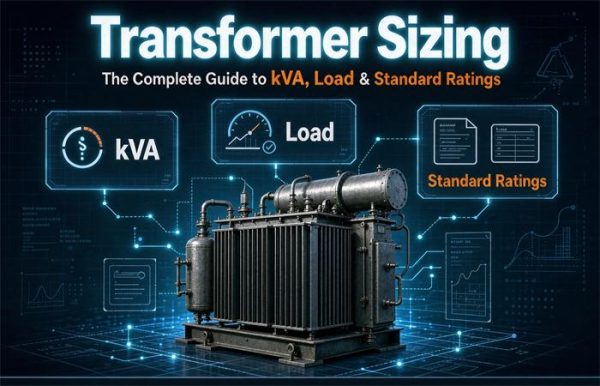
The turns ratio sets voltage. The kVA rating sets how much load the unit can carry. You can have two transformers with the exact same 480 V to 240 V ratio where one is a 5 kVA control transformer and the other is a 500 kVA distribution unit. Match the ratio, then size the kVA to the load. The nameplate guide shows where both numbers live on the plate.
Efficiency: real units lose 1 to 3 percent
Classroom models assume 100 percent efficiency. Real ones do not. Most distribution and dry-type units run between 97 and 99.5 percent efficient, so 0.5 to 3 percent of the energy becomes heat in the core and windings. That loss is a real operating cost over the unit’s life, and it is one reason two quotes at the same ratio can still differ in lifetime price.
Tap changers: fine-tuning the ratio
The nameplate ratio is the nominal value. Most distribution transformers carry taps at plus or minus 2.5 percent steps, often plus or minus 5 percent total, so you can nudge the output up or down when the incoming voltage runs high or low. A unit tagged 480 V to 240 V with a minus 2.5 percent tap can deliver about 234 V instead. That small adjustment keeps sensitive loads happy without swapping the transformer.
Impedance and the ratio
Impedance, measured as a percent, is separate from the turns ratio, but buyers feel it at fault time. It limits the short-circuit current the secondary can deliver. Two units with the same ratio but different impedance behave differently under a fault, and that changes the breaker and cable sizing downstream. Do not let the ratio alone stand in for a full specification.
How to read the ratio off a nameplate
You do not need to count coils. The plate does it for you. Look for the voltage ratings printed as a pair, such as 13800 V primary and 480 V secondary. Divide the secondary by the primary and you have the ratio. A step-up transformer in renewable service will show the lower number on the generator side and the higher on the grid side. If the voltages on the plate do not match your supply and load, the ratio is wrong for your job, no matter how good the price.
Common mistakes when specifying by ratio
The first mistake is treating ratio as capacity. Buyers sometimes order the right voltage conversion at the wrong kVA and wonder why the unit overheats. The second is ignoring the standard. A unit built to IEC may carry different tap, impedance, and temperature assumptions than one built to ANSI/IEEE, even at the same ratio. The IEC versus ANSI guide lays out where those two worlds diverge so a supplier claim reads correctly. The third mistake is forgetting the tests. A ratio that looks perfect on paper means little if the unit never passed routine testing. The routine testing write-up lists the reports you should see before the unit ships.
FAQ
What is the turns ratio of a transformer? The turns ratio is the number of secondary winding turns divided by primary turns, written Ns/Np. It equals the secondary voltage divided by primary voltage (Vs/Vp). A ratio above 1 means step-up, below 1 means step-down.
What is the difference between a step-up and a step-down transformer? A step-up transformer has more secondary turns than primary, so it raises voltage and lowers current. A step-down transformer has fewer secondary turns, so it lowers voltage and raises current. The coil count comparison is the whole difference.
Does a transformer change frequency? No. A transformer passes the input frequency straight through. Feed 60 Hz and you get 60 Hz out. Only the voltage and current scale with the turns ratio.
Can a transformer work on DC? No. Direct current makes a steady magnetic field, not a changing one, so it induces no voltage in the secondary. Transformers require alternating current to function.
How do I calculate the output voltage from the turns ratio? Use Vs = Vp times (Ns/Np). If the primary is 480 V and the secondary has half the turns, the output is 240 V. Multiply the input voltage by the secondary over primary turn count.
What does a 480 V to 240 V transformer ratio mean? It means the secondary has half the primary turns and the unit is a step-down transformer. The 0.50 ratio takes 480 V input to 240 V output while roughly doubling the current.
Is turns ratio the same as the kVA rating? No. The turns ratio sets the voltage conversion only. The kVA rating sets how much load the unit can carry. Two transformers can share a ratio yet differ 100 times in capacity.
Bottom line
A transformer is simpler than it looks. Two coils, one core, and a ratio fixed by the winding counts. Step-up means more secondary turns and higher voltage; step-down means fewer and lower. The formula Vs/Vp = Ns/Np is all you need to predict the voltage. The part most guides skip is the buyer reality: the ratio is only one line of the spec. You still have to size the kVA, pick the right standard, check the taps and impedance, and confirm the tests. For a fuller buying picture, the complete power transformer guide for 2026 walks through rating, cooling, and selection in order. If your project needs a unit built to a specific ratio and standard, the team at TransNorth Electric can spec it with you before you commit a budget.
Free: Transformer Specification Checklist
The exact RFQ sheet our engineers use — send it and get a quoted proposal within 24h.
Download checklist